

Why February Celebrates the Amethyst Stone Birthstone

Why Amethyst Is February's Birthstone
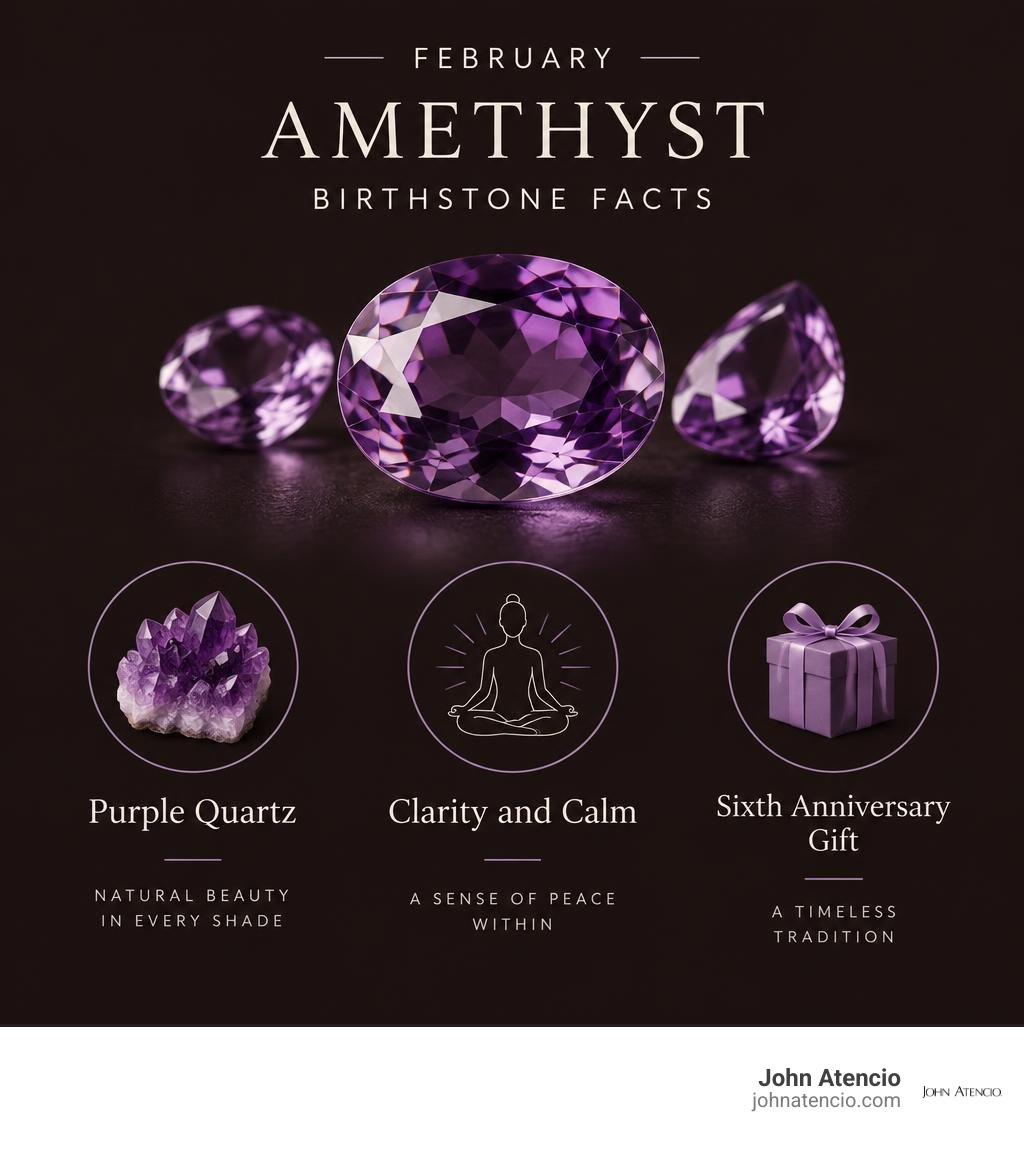
Amethyst is February's birthstone. This purple variety of quartz has long stood for clarity, calm, and protection. Its color ranges from soft lilac to deep violet, making it a personal choice for a February birthday gift. Amethyst is also a traditional gift for a sixth wedding anniversary.
This guide looks at the stories behind the stone, what gives it its color, and how to choose and care for amethyst jewelry. If you're planning a gift, John Atencio typically ships in-stock styles via FedEx 2-day service, and online orders can ship to Canada. Custom engagement rings and special orders typically take 6-8 weeks to hand-craft.
I'm Lex Atencio, Executive Vice President at John Atencio Jewelry. My experience in fine jewelry informs this guide to the amethyst stone birthstone and the choices that make a piece feel personal.
The Origins and History of the Amethyst Stone Birthstone
The lore surrounding the amethyst stone birthstone reaches across continents and millennia. Its name traces back to the ancient Greek word amethystos, which translates directly to "not intoxicated" or "a remedy against drunkenness." In classical antiquity, partygoers wore carved amethyst amulets and sipped wine from chalices fashioned from purple quartz, convinced the gem would keep their minds clear and prevent overindulgence.
According to Greco-Roman mythology, the stone's vivid hue owes its existence to the god of wine, Dionysus (known as Bacchus in Roman lore). Angered by an insult from a mortal, Bacchus declared that the next human to cross his path would be devoured by fierce tigers. A young maiden named Amethyste, on her way to pay tribute to the goddess Diana, happened upon the enraged god. To spare the maiden from a brutal fate, Diana transformed her into a statue of pure, crystalline quartz. Moved by remorse upon seeing the petrified maiden, Bacchus wept and poured his goblet of red wine over the clear quartz, staining the crystalline structure with its rich, signature violet hue.
Throughout antiquity and the Middle Ages, the historical use of amethyst extended far beyond mythology. Because purple dye was extraordinarily difficult to manufacture, natural purple gemstones were reserved for emperors, monarchs, and the highest ranks of religious leadership. Medieval Christian clergy embraced the gem as a profound emblem of piety, celibacy, and spiritual serenity; bishops routinely wore episcopal rings set with polished amethyst cabochons to symbolize holy devotion and clear judgment.

For centuries, amethyst was counted among the cardinal gems—standing equal in prestige, rarity, and value with emeralds, rubies, and sapphires. It featured prominently in the British Crown Jewels and became a signature favorite of Empress Catherine the Great of Russia, who dispatched mineral scouts deep into the Ural Mountains of Siberia to unearth the finest specimens. It was not until the discovery of massive deposits in South America during the nineteenth century that amethyst transitioned from an exclusively royal luxury into an accessible, beloved treasure for jewelry collectors around the globe. Today, in addition to celebrating February birthdays, amethyst is cherished as the traditional commemorative gem for the sixth wedding anniversary.
Gemological Properties: Formation, Color, and Types
Amethyst belongs to the macrocrystalline quartz family, sharing an identical base chemical formula of silicon dioxide (SiO2) with rock crystal, rose quartz, and citrine. On the Mohs scale of mineral hardness, amethyst rates a dependable 7, giving it sufficient scratch resistance for fine heirloom jewelry and everyday wear.
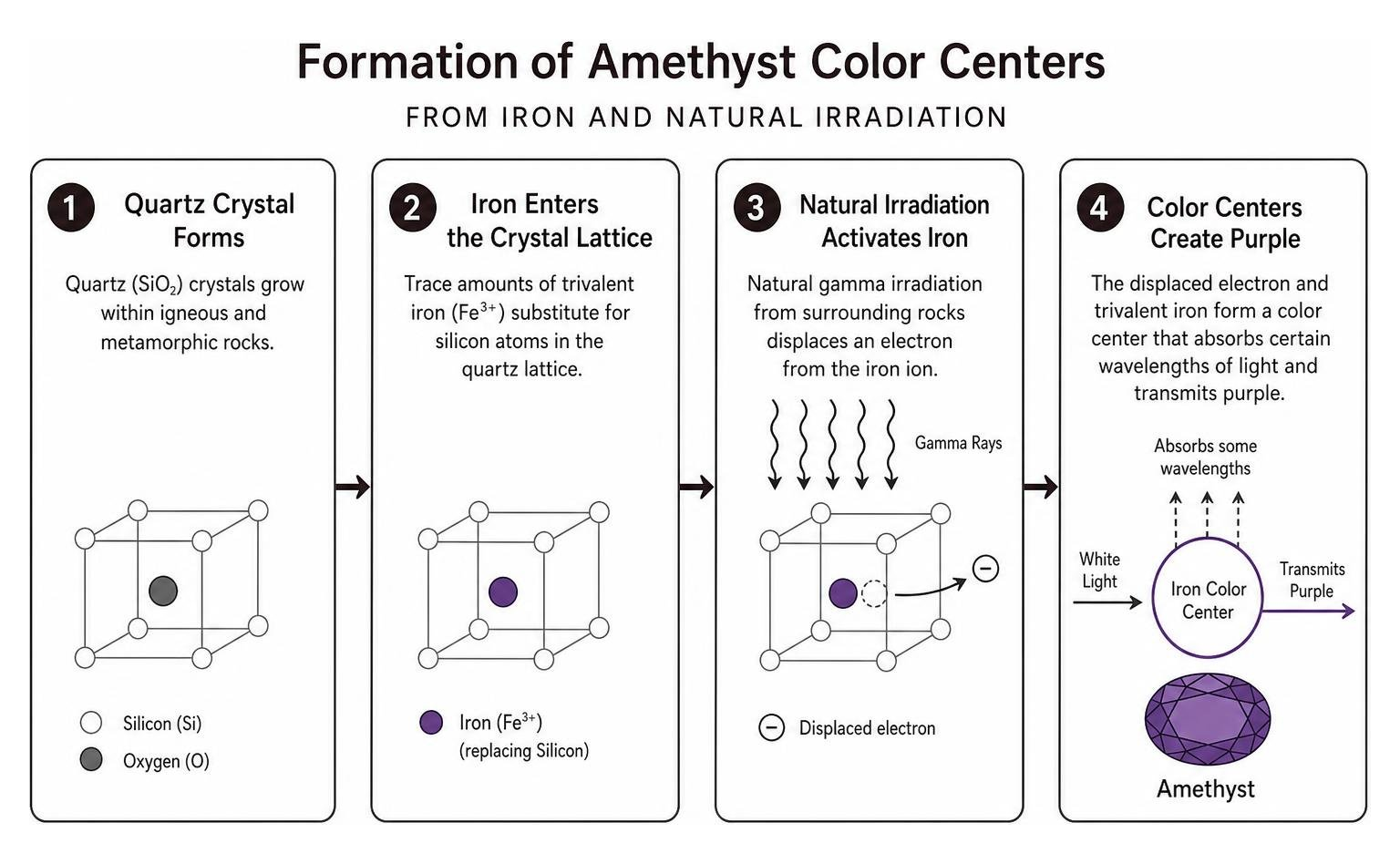
The gemstone's mesmerizing purple color is a masterpiece of geological chemistry. Within the Earth's crust, quartz crystals develop inside igneous and metamorphic rocks. When minute trace amounts of trivalent iron (between 0.2 and 0.5 parts per million of Fe³⁺) substitute for silicon atoms within the quartz crystal lattice, natural ionizing gamma irradiation from surrounding host rocks over millions of years activates these iron ions. This natural radiation displaces an electron, creating unique "color centers" that absorb specific wavelengths of light and transmit the captivating spectrum of violet.
In the gemological trade, amethyst color is evaluated on hue, tone, and saturation:
- Deep Siberian: The most coveted and valuable grading grade. It showcases a primary purple hue of approximately 75% to 80%, complemented by 15% to 20% vivid secondary blue and flash-red undertones. While historical Siberian mines have long been exhausted, the term remains the industry benchmark for premier color saturation.
- Rose de France: Characterized by soft, romantic pastel tones of lilac, mauve, and lavender. Once overlooked by traditional collectors, these lighter shades have experienced a major resurgence in contemporary fine jewelry design.
- Thermal Transformations: Amethyst is inherently sensitive to high heat. When subjected to temperatures beyond 250 °C (482 °F), its iron color centers break down, causing the crystal to shift permanently from purple to golden-yellow, green (prasiolite), or brownish-orange. Much of the commercial golden citrine on the market today begins as heat-treated amethyst.
Comparing Natural, Treated, and Synthetic Varieties
The fine jewelry market includes natural gems, lab-created alternatives, and heat-treated stones. Distinguishing among them requires an understanding of how each is produced and identified.
Synthetic amethyst has been produced commercially via hydrothermal growth since the 1970s. In high-pressure autoclaves, nutrient-rich solutions replicate the heat and pressure of the earth, producing quartz that shares the exact chemical, physical, and optical properties of mined stones. Gemologists distinguish synthetic amethyst from natural gems by inspecting them under specialized polarizing filters and high magnification. Natural stones frequently exhibit characteristic Brazil law twinning, angular color zoning, and tiny mineral inclusions, whereas synthetic crystals tend to display flawless, unnatural uniformity.
Understanding the science behind lab-created gemstones empowers collectors to choose the style, authenticity, and design integrity that aligns with their personal values.
| Gemstone Type | Mineral Composition | Color Mechanism | Color Stability | Market Value & Collectibility |
|---|---|---|---|---|
| Natural Amethyst | Natural Macrocrystalline Quartz (SiO2) | Fe³⁺ iron impurities + natural gamma irradiation | High (can fade under prolonged, intense UV exposure) | Premium value based on cut, carat, and "Deep Siberian" saturation |
| Heat-Treated Quartz | Altered Natural Quartz | Thermal alteration of iron oxidation states | Stable under standard conditions; heat-sensitive | Moderate; often sold as golden citrine or green prasiolite |
| Synthetic Amethyst | Hydrothermally Grown Quartz (SiO2) | Lab-introduced iron ions + controlled irradiation | High; uniform color distribution | Lower; accessible alternative without natural geological provenance |
Symbolism, Metaphysical Lore, and Astrological Harmony
Throughout history, philosophers, healers, and spiritual practitioners have celebrated amethyst as an energetic talisman of balance, peace, and spiritual fortitude. Rather than representing passive stillness, amethyst embodies quiet strength—a grounded energy that filters mental clutter while keeping the wearer anchored in self-possession.
In modern metaphysical and mindfulness practices, amethyst is intimately linked with the higher energy centers:
- The Third Eye Chakra (Ajna): Positioned between the brows, this energy center governs intuition, clarity of perception, and creative vision. Wearing amethyst is believed to quiet circular thoughts, enhance decision-making, and encourage thoughtful introspection.
- The Crown Chakra (Sahasrara): Located at the vertex of the head, the crown chakra represents spiritual connection and universal consciousness. Amethyst's high vibrational frequency is often incorporated into meditation rituals to encourage inner peace and release daily anxieties.
Aligning the Amethyst Stone Birthstone with Aquarius and Pisces
As the dedicated birthstone for February, amethyst shares an innate cosmic harmony with the two zodiac signs dividing the month: Aquarius (January 20 – February 18) and Pisces (February 19 – March 20).
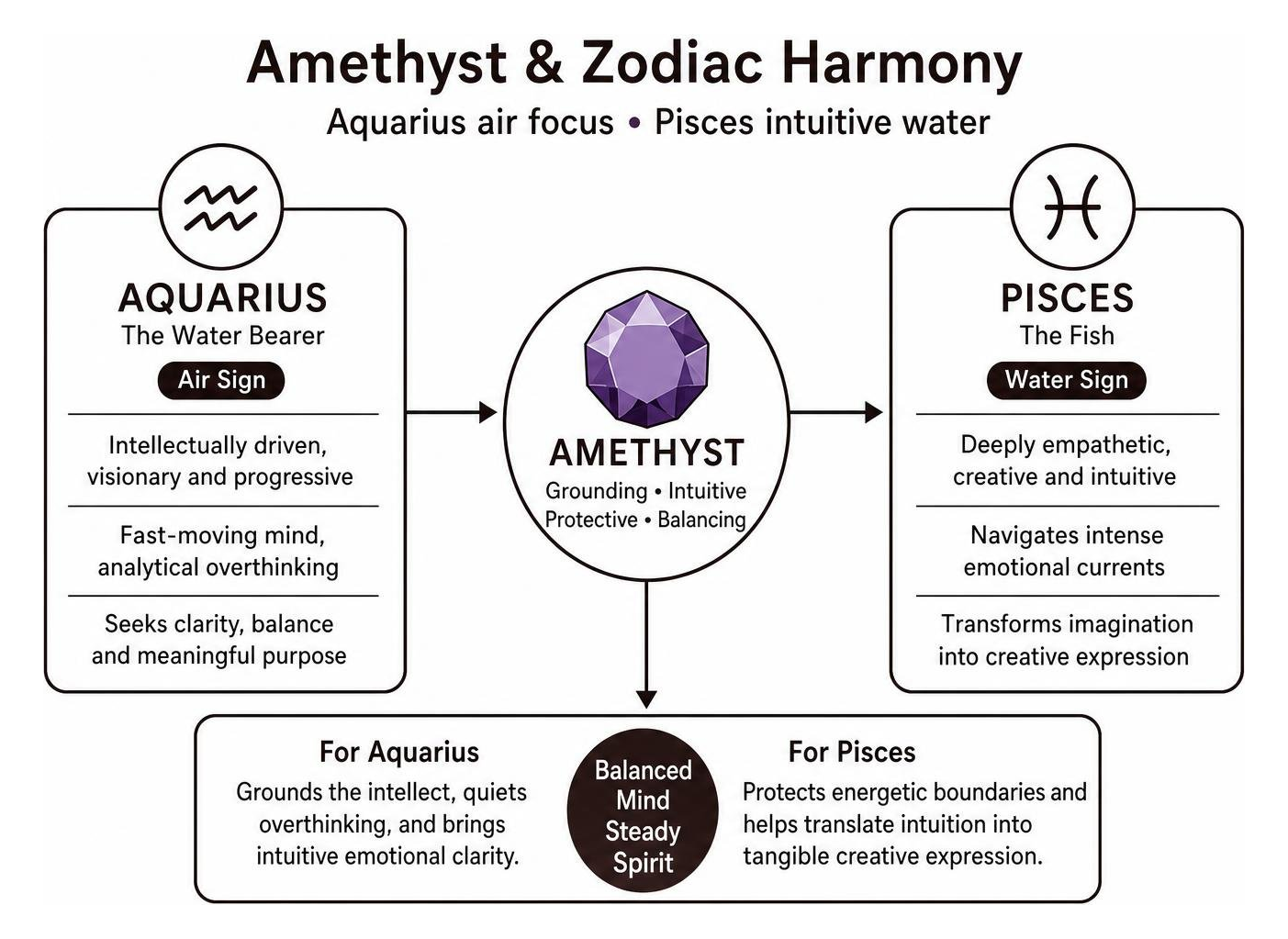
- Aquarius (The Water Bearer): Although symbolized by water, Aquarius is an intellectually driven air sign ruled by visionary ideas and progressive reform. Amethyst provides a grounding anchor for the fast-moving Aquarian intellect, balancing analytical overthinking with intuitive emotional clarity.
- Pisces (The Fish): Deeply empathetic, creative, and intuitive, Pisceans often navigate intense emotional currents. Amethyst acts as a protective shield for Pisces, helping preserve energetic boundaries and translating boundless imagination into tangible creative expression.
Sourcing, Styling, and Care
Fine natural amethyst is discovered within geode cavities and mineral veins across select geological hubs around the world. Every geographic source yields distinct characteristics:
- Zambia (Kariba Mine): One of the world's most productive gemstone hubs, yielding roughly 1,000 tons of high-grade amethyst annually. Zambian material is renowned for its intense, saturated royal purple and dramatic crimson flashes.
- Brazil (Rio Grande do Sul): Famous for producing massive, hollow basalt geodes filled with glittering quartz crystals. Brazilian amethyst spans from delicate lilac tones to balanced medium violets.
- Uruguay (Artigas): Yields exceptional, dark violet crystals with high saturation, often characterized by a distinctive natural rust-toned iron-oxide line along the outer matrix.
- North America: The largest commercial deposit in North America resides in Thunder Bay, Ontario, celebrated for its unique red-hematite inclusions. In the United States, productive mines operate in Four Peaks, Arizona, while amethyst also holds the distinguished honor of being the official state gemstone of South Carolina.
When it comes to everyday fashion and fine jewelry styling, amethyst's rich violet tones create a sophisticated visual balance across diverse metals. Paired with polished 18-karat yellow gold, the purple gem radiates a regal, warm contrast; set in gleaming platinum or white gold, it takes on an architectural, cool elegance.
For those seeking an unforgettable anniversary or birthday expression, our curated curated February birthstone jewelry pairs vivid natural gemstones with sculptural, hand-crafted metalwork. A standout example is the signature amethyst and diamond ring, which showcases the striking contrast between a brilliant, richly saturated center stone and dazzling accent diamonds.
Caring for Your Amethyst Stone Birthstone Jewelry
Because amethyst ranks at a 7 on the Mohs scale, it is well-suited for daily enjoyment, provided it is treated with thoughtful care. Follow these professional maintenance guidelines to ensure your gemstone retains its fire and brilliance for generations:
- Routine Cleaning: Wash your piece gently in a small bowl of warm water blended with mild, phosphate-free dish soap. Use a soft-bristle toothbrush to carefully clean behind the stone where skin oils and lotions gather, then dry with a lint-free cloth.
- Ultrasonic and Steam Caution: Ultrasonic and steam cleaners should be approached with care. If an amethyst possesses internal fractures, thermal or vibrational shock can cause damage. Professional inspection is recommended prior to machine cleaning.
- Protect from Direct Heat and Light: Prolonged exposure to intense sunlight or tanning beds can gradually cause purple quartz to fade. Store your jewelry safely in a soft-lined jewelry box when not in use.
- Avoid Hard Surface Impact: While quartz is durable, harder gemstones such as sapphires, rubies, and diamonds can scratch it. Store individual pieces in divided pouches to prevent surface contact.
Frequently Asked Questions About Amethyst
What makes amethyst the official February birthstone?
The tradition of linking gemstones to calendar months dates back to the biblical Breastplate of Aaron and historical astrological calendars codified in the eighteenth century. In 1912, the American National Association of Jewelers officially standardized the modern birthstone calendar, designating amethyst as the exclusive gemstone for February. Its historical association with calm introspection, winter purification, and emotional clarity aligns naturally with the transition from deep winter into spring.
Can amethyst be worn as an everyday gemstone?
Yes. With a Mohs hardness of 7, amethyst resists scratches from household dust and normal contact. When secured in protective bezel settings or durable prongs crafted in solid 18-karat gold or platinum, amethyst rings, earrings, and pendants are well suited for regular wear. As with any fine jewelry, removing rings before heavy workouts, gardening, or cleaning with harsh household chemicals will preserve the polish and setting.
How can you distinguish authentic amethyst from glass?
Authentic mined amethyst feels cold to the touch upon initial contact and retains that coolness longer than artificial glass due to its thermal conductivity. Under close inspection, natural amethyst will often reveal subtle, angular color zoning (stripes of varying violet saturation) and minute natural inclusions. Glass imitations often feature spherical air bubbles, perfectly uniform coloration, and soft, rounded facet junctions.
Celebrating February with Handcrafted Artistry
Whether chosen to celebrate a February birthday, honor six years of marriage, or serve as an anchor of calm in daily life, amethyst remains an enduring gem of regal elegance and artistic expression. Its rich color and rich history make it an enduring choice for fine jewelry collections.
Explore our curated collection of thoughtful birthstone gifts or dive deeper into gemstone traditions through a comprehensive guide to birthstones.
Every John Atencio creation is an original work of wearable art, designed in Colorado and hand-crafted with exceptional attention to detail. In-stock styles ship via FedEx 2-day service, while custom engagement rings and special orders typically take 6–8 weeks to hand-craft. Online orders can be shipped throughout the U.S and to Canada, bringing thoughtful design directly to your doorstep.
— Lex Atencio
