

Baguette Diamond Necklace Style Guide: Finding Your Perfect Geometric Piece

Find a Baguette Diamond Necklace With Graphic, Personal Style
A baguette diamond necklace uses slim rectangular diamonds to create clean lines, crisp geometry, and a quieter shimmer than round diamonds. For a bold, modern look, compare a continuous baguette tennis necklace or close-fitting choker. For daily wear, choose a single bar, drop, or geometric pendant. Look for well-matched stones, strong settings that protect the corners, and diamond sourcing you can understand.
Baguette diamonds are step cuts: their long, parallel facets create flashes of light and a sleek, hall-of-mirrors effect rather than intense glitter. That makes them especially compelling for someone who wants jewelry with an Art Deco feel, intentional symmetry, and a story beyond the usual diamond silhouette.
I am Lex Atencio, Executive Vice President at John Atencio, where I help guide the creation of handcrafted fine jewelry, including baguette diamond necklace designs that celebrate distinctive geometry and responsible diamond options. Next, explore the cuts, settings, and necklace styles that can make this linear look your own.

The Allure of Baguette-Cut Diamonds: Geometry and Brilliance
Baguette-cut diamonds have captivated jewelry lovers since the 1920s Art Deco movement, when architecture and fashion shifted toward streamlined lines, verticality, and bold symmetry. Unlike the disco-ball sparkle of round brilliants, a baguette cut delivers an understated, sophisticated luster. Its charm lies in quiet confidence—a mirror-like optical depth that draws the eye into the heart of the gem.
Understanding Step Cuts vs. Brilliant Cuts
To understand the beauty of a baguette, it helps to examine how it manipulates light. Round brilliant diamonds and princess cuts rely on triangular and kite-shaped facets arranged symmetrically to maximize fire and scintillation (the rapid flashes of colored and white light you see when moving the stone).
Baguettes belong to the family of step cut diamonds. These stones feature straight, parallel facets arranged in terraces along the length and width of the diamond. Rather than dispersing light into fragmented sparkles, step cuts produce a clean, linear "hall-of-mirrors" effect.
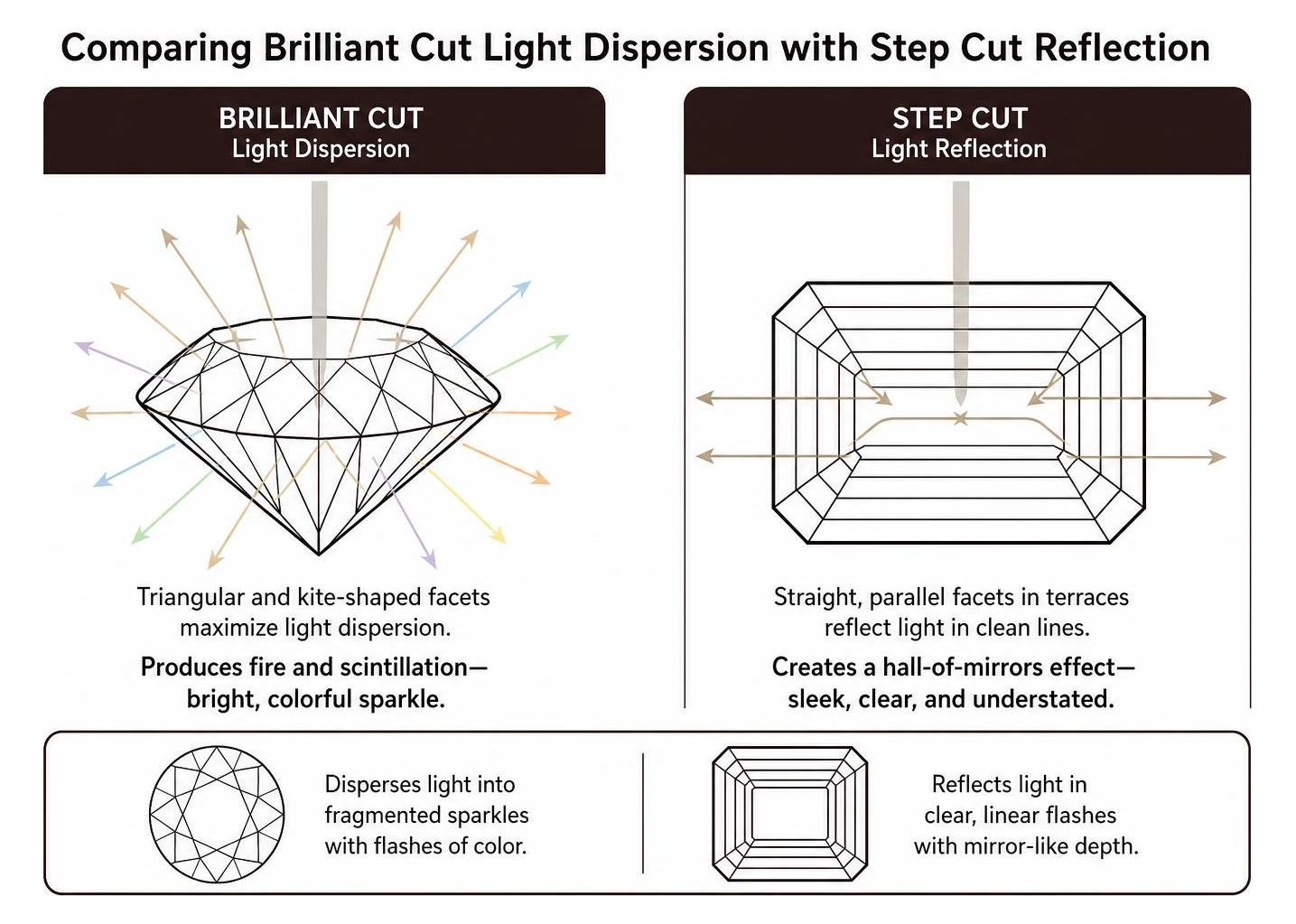
While closely related to emerald cut stones, baguettes typically have fewer facets (usually around 14 to 20) and crisp, right-angled corners. This minimal faceting creates exceptional optical transparency, highlighting the purity of the diamond itself.
Tapered vs. Straight Baguettes
Not all baguettes share the same rectangular proportions. When shopping for necklaces, you will encounter two primary shapes:
- Straight Baguettes: Classic rectangular stones where opposite sides are parallel. These stones bring architectural rhythm to continuous rows, bar pendants, and grid-like geometric arrangements.
- Tapered Baguettes: Stones that narrow slightly on one end, forming an elongated trapezoid. Designers often use tapered baguettes to create radiating sunburst motifs, chevron drops, or curved necklace arches.
How these stones are mounted also shapes the overall aesthetic. Channel settings nestle baguettes edge-to-edge between sleek metal walls for a fluid, snag-free finish. Bezel settings frame each stone in precious metal to accentuate clean outlines and protect vulnerable corners, while prong settings let additional light enter through the sides for added brilliance.
Trending Baguette Diamond Necklace Styles to Elevate Your Look
Whether your aesthetic leans toward minimalist sophistication or dramatic red-carpet glamour, baguette diamonds adapt effortlessly across varied necklace silhouettes.
The Modern Baguette Diamond Necklace in Tennis Silhouette
The classic tennis necklace has undergone a structural transformation. Instead of traditional round stones, contemporary diamond tennis necklaces featuring baguette cuts offer a fluid ribbon of graphic brilliance.
When set horizontally (end-to-end), baguettes create an unbroken line of liquid light around the collarbone. When set vertically (side-by-side), they form a wider, architectural collar with striking texture. These pieces transition seamlessly from daywear to formal evening gatherings, offering an elevated alternative to conventional diamond strands.
Geometric Pendants and Minimalist Drops
For everyday wear, geometric pendants capture the essence of step-cut diamonds in refined, wearable forms. Vertical bar pendants elongate the neck and pair naturally with button-downs and V-neck sweaters. Floating horizontal bars deliver a crisp, modern accent suited for layered looks.
From asymmetrical clusters to refined center stones framed by step cuts, our curation of diamond pendants and sculptural diamond pendants in gold highlights how geometric stones create striking focal points without overwhelming your wardrobe.
Layered Baguette Diamond Necklace Arrangements
Layering fine jewelry allows you to express your individual style through contrasting textures and lengths. Because baguette necklaces have clean, structured lines, they pair beautifully with delicate cable chains, rope textures, or round diamond pieces.
To create a balanced neck stack:
- Anchor with Geometry: Start with a close-fitting baguette choker or horizontal bar pendant as your geometric base.
- Introduce Softness: Add a slightly longer chain with a round diamond pendant or organic motif to soften the angles.
- Coordinate the Suite: Complete your look by pairing your necklace arrangement with timeless diamond studs or curated pieces from our diamond essentials line to maintain visual harmony.
How to Select Diamond Quality and Carat Weight
Because baguette diamonds feature broad, open table facets and minimal step faceting, they do not conceal internal characteristics as readily as brilliant cuts. Knowing what to prioritize ensures your necklace remains radiant and visually pure.
- Clarity Comes First: Inclusions (internal characteristics) that hide easily within the busy facets of a round brilliant are visible under a baguette’s open table. We recommend aiming for VS1 or VS2 clarity grades to ensure an eye-clean appearance.
- Color Uniformity: In necklaces featuring multiple baguettes—such as tennis necklaces or multi-stone pendants—color consistency is paramount. Even a slight variation between adjacent stones can disrupt the seamless aesthetic. Look for stones graded within the Near Colorless range (G–H) or higher.
- Carat Weight & Proportions: Total carat weight matters, but symmetry and aspect ratio dictate how balanced the piece looks against the skin. Baguettes that are matched in length, width, and facet depth will display consistent brilliance.
When choosing your stones, consider whether you prefer conflict-free our diamonds sourced through responsible mining initiatives or modern, eco-conscious lab-grown diamonds search selections that deliver identical chemical, optical, and physical properties with exceptional clarity.
Setting Types: Pros and Cons for Baguette Diamonds
| Setting Style | Aesthetic Appeal | Corner Protection | Light Performance |
|---|---|---|---|
| Channel Setting | Sleek, continuous ribbon of sparkle; vintage Art Deco character | Excellent; guards delicate edges and corners | Moderate; light enters primarily through the top table |
| Bezel Setting | Modern, bold, frame-like outline that emphasizes geometric shapes | Superior; fully encases outer perimeter | Subtle; emphasizes mirror luster over lateral light reflection |
| Prong Setting | Open, delicate look; allows diamond geometry to stand out | Moderate; requires precise claw placement on corners | High; maximizes lateral light entry for extra brilliance |
Caring for Your Geometric Diamond Jewelry
Diamonds are the hardest natural substance on Earth (scoring a 10 on the Mohs scale), but the straight 90-degree corners of baguette cuts can be susceptible to chipping if struck hard against a surface. Proper care preserves both the stones and their precious metal mountings.
- Routine At-Home Cleansing: Soak your necklace in warm water mixed with a few drops of mild dish soap. Use an ultra-soft toothbrush to gently clean behind the step facets, where skin oils and lotions gather. Rinse thoroughly in warm water and pat dry with a lint-free microfiber cloth.
- Avoid Harsh Chemicals: Keep your jewelry away from chlorine, bleach, and abrasive cleaners, which can weaken precious metals over time.
- Mindful Storage: Store your baguette necklace flat in a fabric-lined jewelry box or individual pouch to prevent chains from tangling and stones from scratching softer gemstones.
- Professional Checkups: Have your necklace inspected by an experienced jeweler once a year to verify prong tension, channel security, and clasp integrity.
Frequently Asked Questions About Baguette Diamonds
How does a baguette cut differ from an emerald cut?
While both are step cuts, an emerald cut features cropped, diagonal corners resulting in an octagonal silhouette with approximately 57 facets. A baguette cut features sharp, 90-degree rectangular corners and significantly fewer facets (typically 14 to 20), giving it a more minimalist, graphic appearance.
Are baguette diamonds durable for daily wear?
Yes. Diamonds are exceptionally durable for daily wear. However, because baguette cuts have pointed corners rather than cropped edges, choosing a protective setting—such as a bezel, channel, or corner-cap prong setting—ensures long-term resilience for active lifestyles.
Why are clarity and color critical for baguette diamonds?
Brilliant cuts disperse light in multiple directions, which helps camouflage minor inclusions and faint body color. Baguettes feature wide, transparent tables that act like clear windows into the diamond. Flaws or uneven color matching become immediately noticeable, making quality selection vital.
Conclusion
A baguette diamond necklace is more than fine jewelry—it is a statement of wearable art that celebrates balance, architectural beauty, and timeless modernism. Whether you prefer the dramatic sweep of an unbroken collar or the subtle geometry of a gold-set pendant, these linear designs offer an enduring alternative to traditional silhouettes.
To explore the nuances of linear diamond styles and find the right piece for your collection, visit our diamond tennis necklace guide and discover the art of hand-crafted design.