


Glossary: Medallion
A medallion is a pendant, typically circular or oval, featuring engraved, sculpted, or symbolic imagery intended to be worn as a personal expression of identity, belief, memory, or meaning. Unlike a purely decorative pendant, a medallion carries intention at its center. Its form holds the story. What it represents is the point.
Medallions are worn on chains or necklaces and may range from minimalist discs to intricately detailed pieces featuring spiritual imagery, personal symbols, initials, or custom motifs. What unites them, across every era and every design, is purpose. A medallion may be worn for its beauty -but it is often chosen for the meaning it carries. At John Atencio, medallions are designed with the same principles that guide every piece: architectural proportion, refined craftsmanship, and the belief that jewelry should carry intention as well as beauty.
"A medallion carries meaning before it carries shine. It tells a story sometimes quietly, sometimes boldly, but always intentionally." John Atencio.

What Makes a Medallion a Medallion
The word medallion shares its root with medal, a fitting origin for a piece of jewelry whose entire identity is built around significance.
A pendant becomes a medallion when it moves beyond decoration into symbolism. The distinction is meaningful. A pendant may feature a gemstone, a geometric form, or a sculptural element chosen purely for its beauty. A medallion is chosen for what it represents, and its visual character flows from that meaning outward.
The circle, the most common medallion form, is not an accident of design. It is one of the oldest symbols in human culture: wholeness, continuity, eternity. A shape with no beginning and no end. When worn close to the body, a circular medallion carries all of that quietly, a personal universe held in precious metal.
Oval and elongated medallion forms offer a slightly more directional presence, suited to designs that emphasize movement, figure, or narrative. The form chosen for a medallion is itself a design decision, and at John Atencio, it is never made casually.
Not every medallion announces itself. Some are worn privately, turned inward, tucked beneath clothing, known only to the wearer. Others are meant to be seen. The best medallions work in both directions: visually considered enough to hold up under attention, and personally meaningful enough to matter when no one is looking.
A History of Medallions
Medallions are among the oldest forms of wearable jewelry, and their history reveals something enduring about human nature: we have always wanted to carry meaning on our bodies.
Ancient civilizations created medallions as protective amulets and symbols of devotion. Greek and Egyptian artisans crafted pieces honoring deities, rulers, and mythological figures worn to invoke power, seek protection, or mark identity within a culture. These earliest medallions were not decorative objects. They were functional ones. They were believed to do something to protect, to connect, to signify.
Ancient Rome elevated the medallion into a formal symbol of achievement. Military leaders and soldiers received commemorative medallions in recognition of valor and distinguished service. The tradition of the medal as honor still alive in military and civic culture today originates here. A medallion was earned. Wearing it communicated something specific about who the wearer was and what they had done.
The Middle Ages brought religious meaning to the form. Christian medallions featuring saints, sacred symbols, and devotional imagery were worn as expressions of faith and spiritual protection. The medallion became an act of belief made visible. Many of these traditions persist religious medallions honoring saints or spiritual symbols remain among the most personally significant pieces in fine jewelry today, worn for reasons that have nothing to do with fashion.
The Renaissance introduced the portrait medallion sculpted profile portraits engraved into precious metal, commemorating family lineage and celebrating the individuals who shaped a legacy. These pieces were not fashion. They were history, made wearable. They captured not just likeness but identity, intention, and continuity across generations.
The 18th and 19th centuries brought the mourning medallion lockets and engraved discs containing miniature portraits, inscriptions, or locks of hair, worn to carry the memory of someone lost. These pieces represent the medallion form at its most intimate: jewelry as private memorial, worn not for the world but for the wearer alone.
Modern jewelry inherited all of this. Today's medallions honor the same human impulses faith, identity, memory, achievement but express them through a contemporary design vocabulary. Zodiac symbols, initials, abstract motifs, spiritual imagery, and personal inscriptions continue a tradition that spans millennia.
The form has changed. The intention has not.
The Symbolism of the Circle
Most medallions are circular, and that form carries its own deep history of meaning.
The circle has appeared as a sacred symbol across virtually every culture and civilization from ancient mandalas and Celtic knotwork to Japanese ensō and the halos of Christian iconography. It is the shape of the sun, the moon, and the horizon. It has no beginning and no end, making it a natural symbol of wholeness, eternity, and continuity.
In jewelry, the circle also creates visual harmony. It distributes weight evenly, sits naturally against the body, and pairs gracefully with any neckline or chain length. Its proportions are inherently balanced a quality that aligns closely with John Atencio's design philosophy, which has always prioritized structure and geometric resolution over ornamentation.
Oval and elongated medallion forms introduce directionality a subtle sense of movement or verticality that suits certain symbols and design intentions. Symbols with natural orientation, such as figures, portraits, or directional motifs, often translate more effectively into an elongated form.
The choice of shape is never incidental. It is the first design decision, and it shapes everything that follows.

Why Medallions Endure
In an era of fast-changing jewelry trends, the medallion remains a constant. Its staying power is not accidental.
Symbolism does not date. A medallion chosen for what it represents a birthstone, a zodiac sign, a spiritual symbol, a set of initials will mean the same thing in thirty years as it does today. Design trends come and go. Personal meaning is permanent.
The form is inherently versatile. A single medallion worn alone is a signature piece. Layered with other medallions or minimalist chains, it becomes part of a curated, evolving personal story. The same piece can be dressed up or worn casually, layered or solo, without losing its character.
Medallions reward longevity. Unlike pieces chosen for seasonal appeal, a well-crafted medallion deepens in meaning over time. It accumulates the weight of the moments it has witnessed, the days it was worn, the occasions it marked, the hands it eventually passed through. Many of the most treasured pieces in any collection are medallions that have been worn for decades.
They are designed for the wearer, not the observer. Many medallions carry symbols that are entirely private. Their meaning belongs to the person wearing them. This inward quality jewelry as personal truth rather than outward display resonates deeply with how many people approach fine jewelry today.
A piece that means something to you is always more powerful than a piece that merely looks good to others.
Design Elements That Define a Medallion
The visual character of a medallion is shaped by a series of deliberate decisions, each of which contributes to how the piece feels and how it carries its meaning.
Shape and scale. The proportions of a medallion determine its presence on the body. A smaller disc sits intimately against the collarbone, quiet and personal. A larger medallion commands attention, making its symbolism visible and bold. Neither is more correct but both must be considered relative to the wearer's proportions, the chain length, and the layering context. Scale should serve meaning, not override it.
Metal choice. Yellow gold is the most traditional medallion metal its warmth and depth complement engraved and sculpted surfaces beautifully, emphasizing detail with contrast. White gold offers a crisper, more architectural quality, well-suited to modern designs with clean geometry. Sterling silver brings its own cool, luminous character and as it joins the John Atencio Medallion Collection, it extends the same expressive design language to a new material with a distinctly contemporary feel.
Surface finish. A high-polish surface catches and returns light dramatically, giving a medallion visual energy and presence. A brushed or matte finish is quieter and more understated a deliberately subdued surface that allows form and symbolism to speak without the distraction of shine. The finish changes the entire personality of a piece, even when every other element remains the same.
Single and double-sided design. Some medallions carry their meaning on one surface. Others are designed to be double-sided a symbol on the face and a second on the reverse, creating a piece that holds two layers of meaning within a single form. The Zodiac medallions in the John Atencio collection use this approach: one side for the symbol, one side for the story behind it. A double-sided medallion rewards the wearer who knows both faces and invites curiosity in those who discover the second.
Engraving and dimension. Engraved medallions feature imagery or text worked into the surface of the metal. Sculpted or raised designs add dimensionality the imagery lifts from the surface, creating depth, shadow, and tactile presence. The quality of this work matters enormously. Crisp, well-balanced engraving reads as intentional and refined. Poorly executed detail loses its clarity over time, particularly as fine gold wears.
Diamond setting. Pavé diamonds introduced into a medallion design add brilliance without altering the symbolic weight of the piece. When set with precision and proportion, diamonds enhance the form they do not compete with it. The John Atencio Lightning Bolt medallion, for example, uses pavé diamonds to trace the line of the design, adding light and energy without softening its bold, expressive form.
Medallion vs. Pendant: Understanding the Distinction
The terms are related but not interchangeable, and the difference matters when choosing fine jewelry with intention.
A pendant is a broad category any jewelry piece suspended from a chain or necklace. A pendant may feature a gemstone, a sculptural form, or a decorative element with no particular symbolic meaning. It is chosen for how it looks.
A medallion is a specific type of pendant distinguished by its symbolic content. The imagery it carries whether engraved, sculpted, or set with meaningful stones gives the piece its identity. It is chosen for what it means.
All medallions are pendants. Not all pendants are medallions.
This distinction helps explain why medallions often carry deeper emotional value than purely decorative pieces and why they are more likely to become heirlooms. A beautiful gemstone pendant may be treasured for its beauty. A medallion is treasured for its story.

Medallion Jewelry at John Atencio
John Atencio's Medallion Collection brings this tradition forward through pieces designed to be worn individually or layered into something deeply personal.
The collection spans a range of symbolic directions. Diamond Initial medallions are crafted in the wearer's own letter personal by definition, refined in execution. The double-sided Zodiac medallions carry a sign on the face and its deeper meaning on the reverse. The Hamsa hand, one of the oldest protective symbols across cultures and faiths, and the Evil Eye, universally recognized as a guardian against misfortune, represent the ancient end of the symbolic spectrum. The Lightning Bolt brings energy, momentum, and expressive confidence to the collection. The Columbine, Colorado's state flower and mountain designs inspired by the iconic profile of Longs Peak, ground the collection in the landscape and character of the place where John Atencio has designed and built for nearly fifty years.
Sterling silver is joining the collection, bringing the same hand-crafted quality and symbolic depth to a material with its own luminous, contemporary appeal.
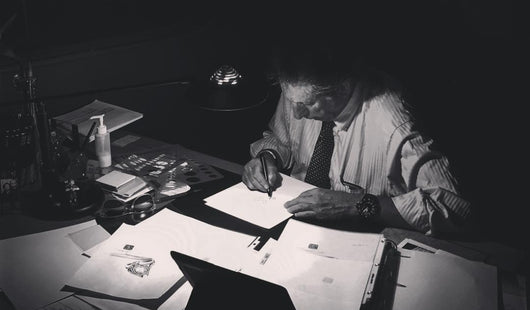
Every medallion begins as a hand-drawn sketch, the same process that governs every John Atencio design, from engagement rings to statement necklaces. Each piece is handcrafted using responsibly sourced diamonds and recycled precious metals. The proportions are resolved with care. The details are finished by hand.
The collection is designed to layer and evolve. A medallion chosen today may be joined by another at a milestone, and another after that. Over time, a layered set of medallions becomes a wearable record of a life's symbols accumulated not by trend, but by meaning.
"A medallion should feel grounded and intentional, something you reach for daily because it feels like you." John Atencio
How to Wear a Medallion
Medallions are among the most wearable pieces in fine jewelry. Their proportional forms sit naturally against the body, and their symbolic weight makes them genuinely personal rather than simply decorative.
Worn alone, a medallion becomes a signature, the one piece that speaks clearly about who you are and what you carry. Positioned on a chain that places it at the collarbone or just below, a single medallion is quietly powerful.
Layered medallions create a visual narrative. Pairing pieces of different scales and symbols a bold, expressive design alongside a delicate initial, a Hamsa alongside an Evil Eye, creates a personal composition that is entirely the wearer's own. Chain styles and lengths should vary when layering: 16, 18, and 20 inches create natural separation without tangling or competing for visual space.
For those who want to wear multiple medallions together as a unified composition, the John Atencio Medallion Circle Clasp offers an elegant solution. Crafted in 14-karat yellow or white gold with a spring-loaded push clasp, this 6mm hoop is designed to hold multiple medallions on a single chain — keeping them grouped, balanced, and beautifully presented. It is a small detail with a considered purpose: allowing a curated set of medallions to move and sit together as one.
Mixed metals add depth and dimension. Yellow gold, white gold, and sterling silver worn together create a warm contrast. The key is intentionality; each piece is chosen for what it contributes to the whole, not simply added for volume.
Caring for Medallion Jewelry
A well-crafted medallion ages beautifully with proper care, and many become the most treasured pieces in a collection over time.
Clean medallion jewelry regularly using warm water, a mild soap, and a soft brush. Pay particular attention to engraved surfaces and pavé settings, where buildup can obscure fine detail. Allow the piece to dry fully before storing.
Avoid abrasive cloths or harsh chemicals, which can soften engraved lines or affect pavé settings over time. Store medallions separately from other jewelry to prevent surface scratching. A soft pouch or individual compartment is ideal.
Professional polishing at any John Atencio boutique can restore the full brilliance of a high-polish surface when needed. For pavé-set medallions, periodic professional inspection ensures stones remain properly seated and secure.
John Atencio offers complimentary cleaning and inspections for all jewelry at every boutique location because a meaningful piece deserves ongoing care, not just a beautiful beginning.
A Symbol Worth Wearing
A medallion necklace is more than an accessory. It is a declaration of identity, of values, of the things worth carrying close.
Across centuries, from ancient amulets to Renaissance portraits to the most expressive designs of today, medallions have always done the same work: they have made the invisible visible, given form to meaning, and allowed people to carry what matters most on their bodies every day.
At John Atencio, every medallion is designed with that purpose at its center. The craftsmanship is precise. The materials are responsibly sourced. The forms are considered. But what gives each piece its true significance is the story of the person who chooses to wear it.
Explore the John Atencio Medallion Collection online, or visit one of our boutiques to discover a piece that tells yours.
Frequently Asked Questions About Medallions
What is a medallion in jewelry?
A medallion is a pendant, typically circular or oval, featuring engraved, sculpted, or symbolic imagery. Unlike a purely decorative pendant, a medallion is defined by its symbolic purpose: it represents identity, faith, memory, achievement, or personal meaning rather than simply serving as an ornament.
What is the difference between a medallion and a pendant?
All medallions are pendants, but not all pendants are medallions. A pendant is a broad category of jewelry worn on a chain or necklace. A medallion is specifically distinguished by its symbolic content, the imagery, engraving, or motif it carries. A gemstone solitaire pendant is decorative; a medallion featuring a zodiac symbol, initial, or spiritual image is meaningful.
Why are most medallions circular?
The circle is one of the oldest and most universal symbols in human culture, representing wholeness, continuity, and eternity. Its balanced proportions also make it naturally suited to wearable jewelry, sitting harmoniously against the body and pairing gracefully with any chain length or neckline. The form carries meaning even before the imagery within it does.
What metals are available for John Atencio medallions?
John Atencio medallions are available in yellow gold and white gold, with sterling silver joining the collection. Each metal brings its own character to the design: yellow gold offers warmth and traditional depth, white gold a crisper architectural quality, and sterling silver a cool contemporary luminosity that suits the expressive nature of the collection beautifully.
What does it mean for a medallion to be double-sided?
A double-sided medallion carries distinct imagery on both the face and the reverse, two layers of meaning within a single piece. The John Atencio Zodiac medallions are designed this way, with a sign on one side and its meaning on the other. It is a detail that rewards the wearer who knows both faces.
What is the Medallion Circle Clasp?
The John Atencio Medallion Circle Clasp is a 14-karat gold hoop with a spring-loaded push clasp, designed to hold multiple medallions together on a single chain. Available in yellow or white gold, it allows wearers to group their medallions into one cohesive composition, an elegant solution for those who want their layered look to move and sit as one.
Can I wear multiple medallions together?
Yes, the John Atencio Medallion Collection is specifically designed for layering. Varying chain styles and lengths, typically 16, 18, and 20 inches, create natural separation between pieces. Mixing symbols, scales, and metals adds depth and personal expression to the look.
How should I care for an engraved or pavé-set medallion?
Clean regularly with warm water, mild soap, and a soft brush, paying careful attention to engraved lines and pavé settings where buildup can accumulate. Avoid abrasive cloths. Professional cleaning and inspection at any John Atencio boutique, offered complimentary, ensures settings remain secure, and the piece retains its full brilliance over time.
Are medallions appropriate as gifts?
Medallions make deeply meaningful gifts precisely because they can be chosen with such personal intention. A zodiac medallion, an initial piece, a spiritual symbol, or a commemorative design all carry significance that extends far beyond the jewelry itself. A medallion given with thought tends to become one of the most-worn and most-treasured pieces a person owns.