

December 14 Birthday Crystals: Meanings, Colors, and Origins

December 14 Birthstones: Three Meaningful Blue Gems
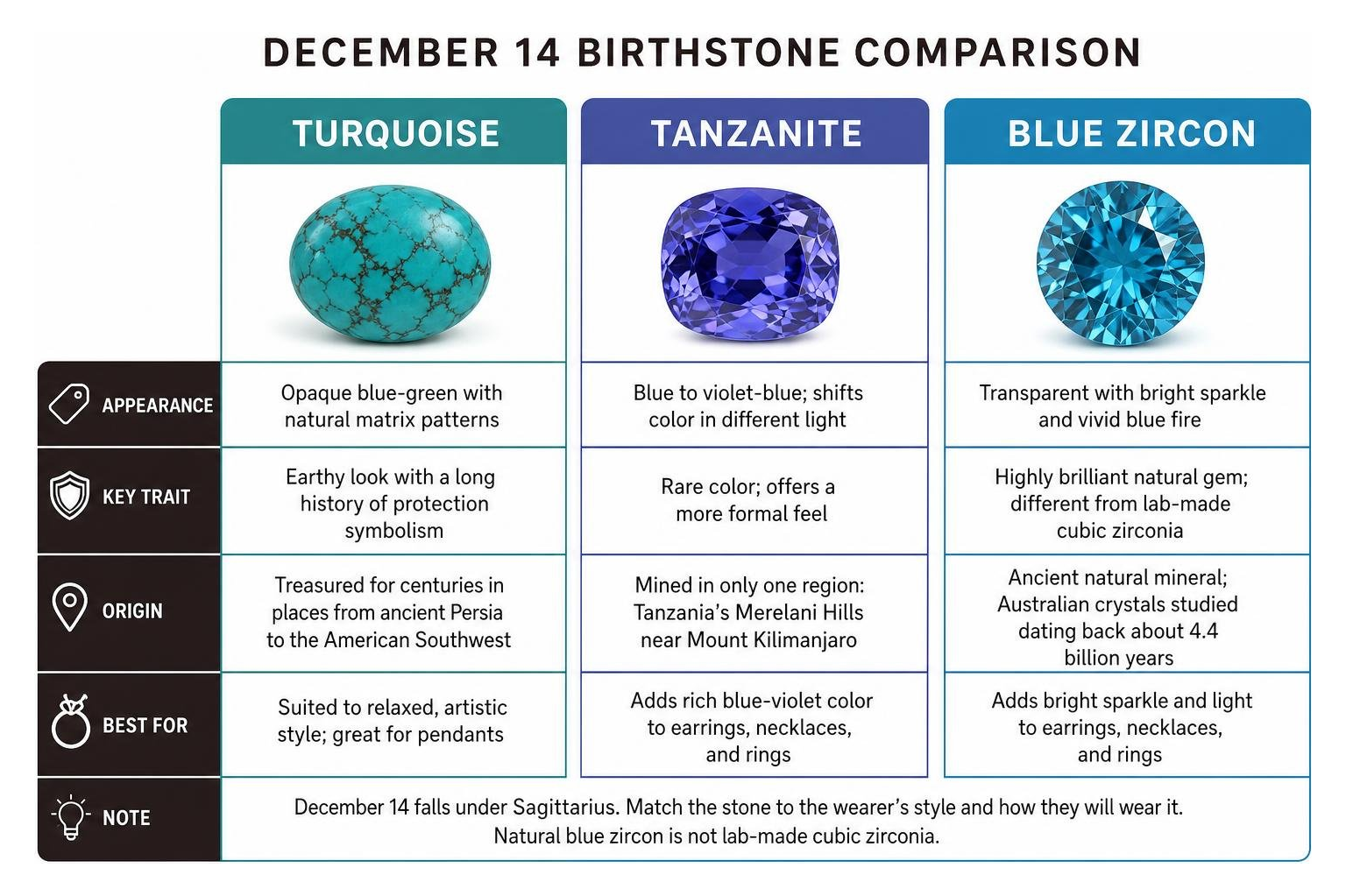
The official birthstones for a December 14 birthday are turquoise, tanzanite, and blue zircon. Choose turquoise for an earthy blue-green look and a long history of protection symbolism, tanzanite for rare violet-blue color and a more formal feel, or blue zircon for bright sparkle and vivid blue fire.
December 14 falls under Sagittarius, and its three birthstones offer very different ways to tell a personal story. Turquoise is opaque and often marked by natural matrix patterns. Tanzanite shifts between blue and violet when viewed in different light. Natural blue zircon is transparent, highly brilliant, and entirely different from lab-made cubic zirconia.
Each gem also comes with a distinct origin. Turquoise has been treasured for centuries in places from ancient Persia to the American Southwest. Tanzanite is commercially mined in only one region: Tanzania's Merelani Hills near Mount Kilimanjaro. Zircon is an ancient natural mineral; crystals from Australia have helped scientists study material dating back about 4.4 billion years.
For a thoughtful gift, match the stone to the wearer's style and how they will wear it. A protected turquoise pendant suits relaxed, artistic style, while tanzanite and zircon can bring rich color and light to earrings, necklaces, and carefully set rings. John Atencio typically ships domestic orders via FedEx 2-day service and does not ship internationally to customers.
I'm Lex Atencio, Executive Vice President at John Atencio Jewelry. I help clients turn a birthstone December 14 connection into handcrafted jewelry that feels personal, bold, and lasting.
The Official Birthstone December 14 Trio: Turquoise, Tanzanite, and Zircon
Few birth dates present as captivating an array of options as December 14th. Rather than being tied to a single stone, celebrating a mid-December birthday invites you to explore a triad of vibrant blue gems: turquoise, tanzanite, and zircon.
The presence of three distinct gems is the result of deliberate historical updates within the gemological world. When modern jewelers standardized the monthly birthstone calendar in 1912, turquoise held the position alongside traditional lapis lazuli. As tastes shifted toward transparent, faceted gems for intricate multi-stone settings, zircon joined the December roster in 1952.
The story evolved further in 2002 when the American Gem Trade Association officially welcomed tanzanite into the fold—marking the first major change to the birthstone registry in decades. If you have ever wondered why some months have multiple birthstones, it often comes down to balancing ancient cultural traditions with breathtaking modern geological discoveries. Today, as detailed in the official GIA guide on December birthstones, all three stones hold equal honor for December 14.
Turquoise: Ancient Protection and Bohemian Heritage
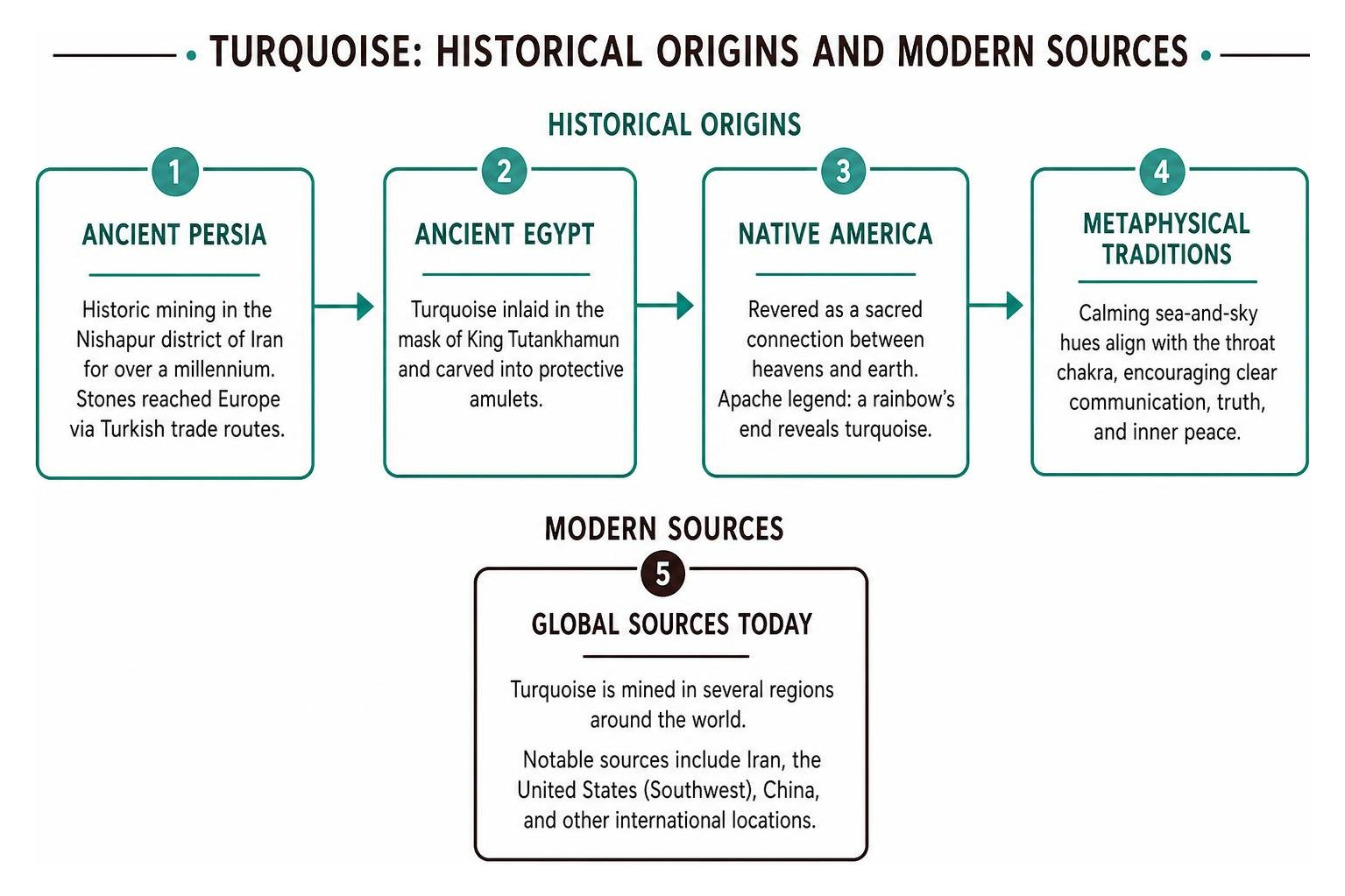
Turquoise is a hydrated copper aluminum phosphate mineral that has captivated human civilizations for thousands of years. The name itself derives from the Old French pierre turquoise, referencing the Turkish trade routes that brought vivid Persian stones into European markets.
Historic mining centered in the Nishapur district of Iran for over a millennium, producing smooth, robin's-egg blue cabochons that decorated royal courts. In ancient Egypt, turquoise was inlaid into the iconic funerary mask of King Tutankhamun and carved into protective amulets. Across North America, Native American tribes revered turquoise as a sacred connection between the heavens and the earth. An Apache legend tells that following a rainbow to its end reveals turquoise buried in the damp soil. In metaphysical traditions, its calming sea-and-sky hues align with the throat chakra, encouraging clear communication, truth, and inner peace.
Tanzanite: Mount Kilimanjaro’s Rare Blue Treasure
In contrast to ancient turquoise, tanzanite is a modern geological miracle. Discovered in 1967 at the foot of Mount Kilimanjaro in Tanzania's Merelani Hills, this gem is found commercially in only one place on Earth. It exists within a small strip of land just a few miles wide.
Tanzanite is the blue-to-violet variety of the mineral zoisite. What makes fine tanzanite mesmerizing is its pleochroism—specifically trichroism—meaning it displays distinct colors (deep sapphire blue, regal violet, and rich burgundy) when viewed from different crystal directions and under varied light sources.
Because commercial production is restricted to this single deposit, tanzanite is considered exceptionally rare. Studies have indicated that these localized reserves could be exhausted within decades at current mining rates. Spiritually, tanzanite resonates with the third eye and crown chakras, representing transformation, creative awakening, and intuitive wisdom.
Natural Blue Zircon: Earth’s Oldest Fiery Mineral
Natural zircon is a zirconium silicate mineral with a rich history of its own. Zircon crystals discovered in the Jack Hills and Harts Range of Australia have been dated at approximately 4.4 billion years old. These specimens are the oldest known mineral fragments on our planet, serving as tiny time capsules that allow geologists to study early Earth.
Prized for its high refractive index and impressive optical dispersion ("fire"), faceted blue zircon rivals the brilliance of diamond. Naturally occurring zircon in brown or reddish hues from locations such as Cambodia and Sri Lanka is routinely heat-treated to unveil an electric, tropical teal-blue shade. To understand how these crystalline traits influence overall design, our glossary birthstone reference offers deeper insight into gemstone terminology. In metaphysical circles, zircon is embraced as a talisman of wisdom, prosperity, and emotional clarity.
Comparative Gemology: Colors, Value, and Identification
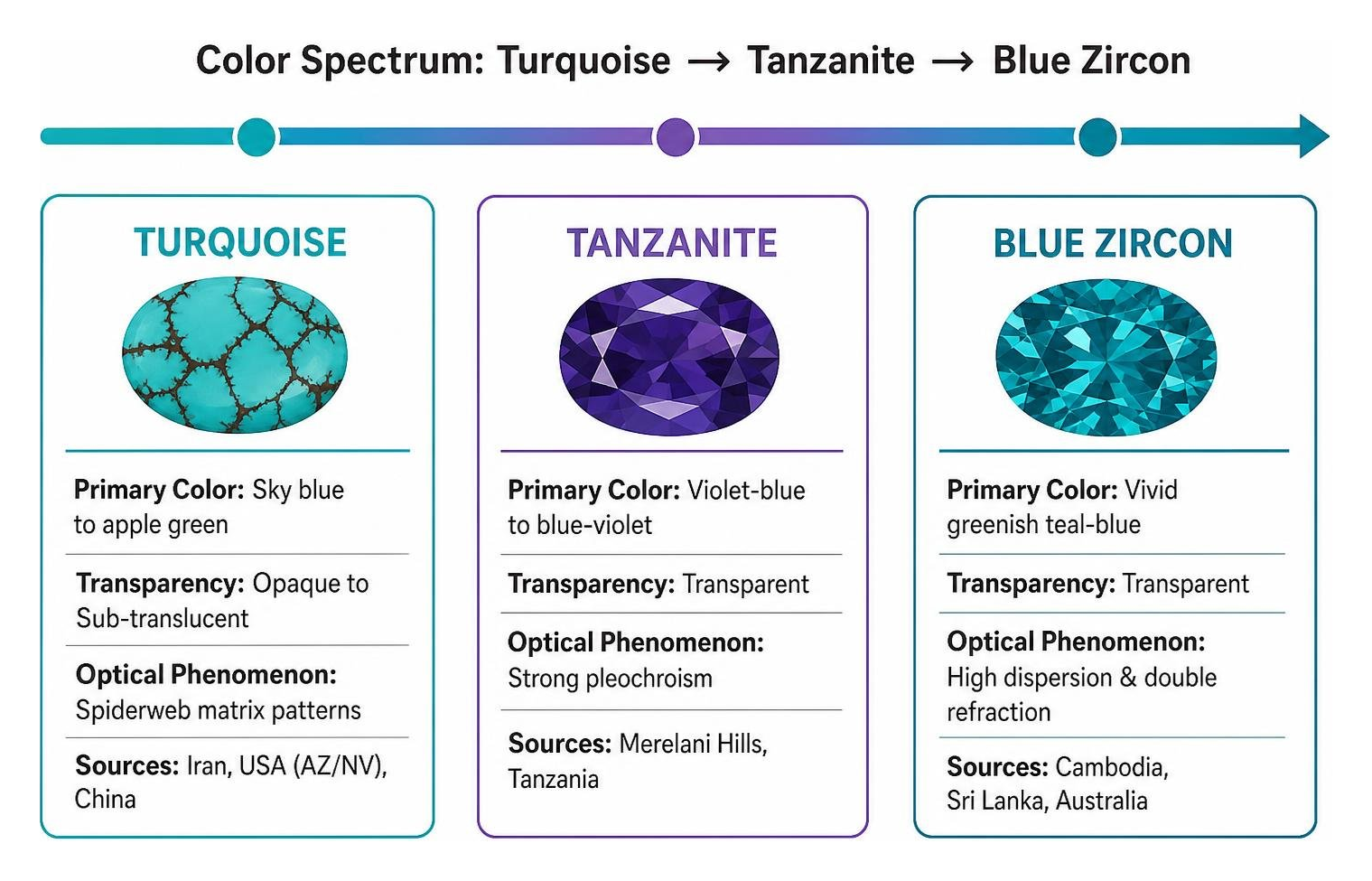
Evaluating the three gemstones associated with a birthstone December 14 celebration requires looking at their distinct physical and optical properties.
| Feature | Turquoise | Tanzanite | Natural Blue Zircon |
|---|---|---|---|
| Mineral Species | Hydrated Copper Phosphate | Zoisite | Zirconium Silicate |
| Mohs Hardness | 5.0 – 6.0 | 6.0 – 7.0 | 6.0 – 7.5 |
| Transparency | Opaque to Sub-translucent | Transparent | Transparent |
| Primary Color | Sky blue to apple green | Violet-blue to blue-violet | Vivid greenish teal-blue |
| Optical Phenomenon | Spiderweb matrix patterns | Strong Pleochroism | High dispersion & double refraction |
| Primary Geographic Sources | Iran, USA (AZ/NV), China | Merelani Hills (Tanzania) | Cambodia, Sri Lanka, Australia |
Understanding the Birthstone December 14 Color Palette and Value
The December palette spans from soft, earthy sky blue to rich violet and shimmering ocean teal. As noted in the Old Farmer's Almanac December birthstone history, the common thread uniting these stones is their connection to winter light and cool tranquility.
Value in these stones is determined by color intensity, clarity, and rarity:
- Tanzanite: Deeply saturated, velvety violet-blue stones command the highest value per carat. Lighter pastel shades are more accessible, while larger, top-grade gems are prized by collectors worldwide.
- Turquoise: Prized specimens feature uniform robin's-egg blue coloration or balanced spiderweb matrix webbing. Highly sought-after stones originate from classic American and Persian mines.
- Blue Zircon: Highly saturated, vivid teal stones with eye-clean clarity and excellent cut precision carry premium appeal, offering remarkable sparkle without approaching the cost of precious blue sapphires.
Identifying Genuine Stones vs Imitations
Because these stones are so popular, imitations exist in the market. Understanding how to identify genuine gems ensures your jewelry remains meaningful and authentic.
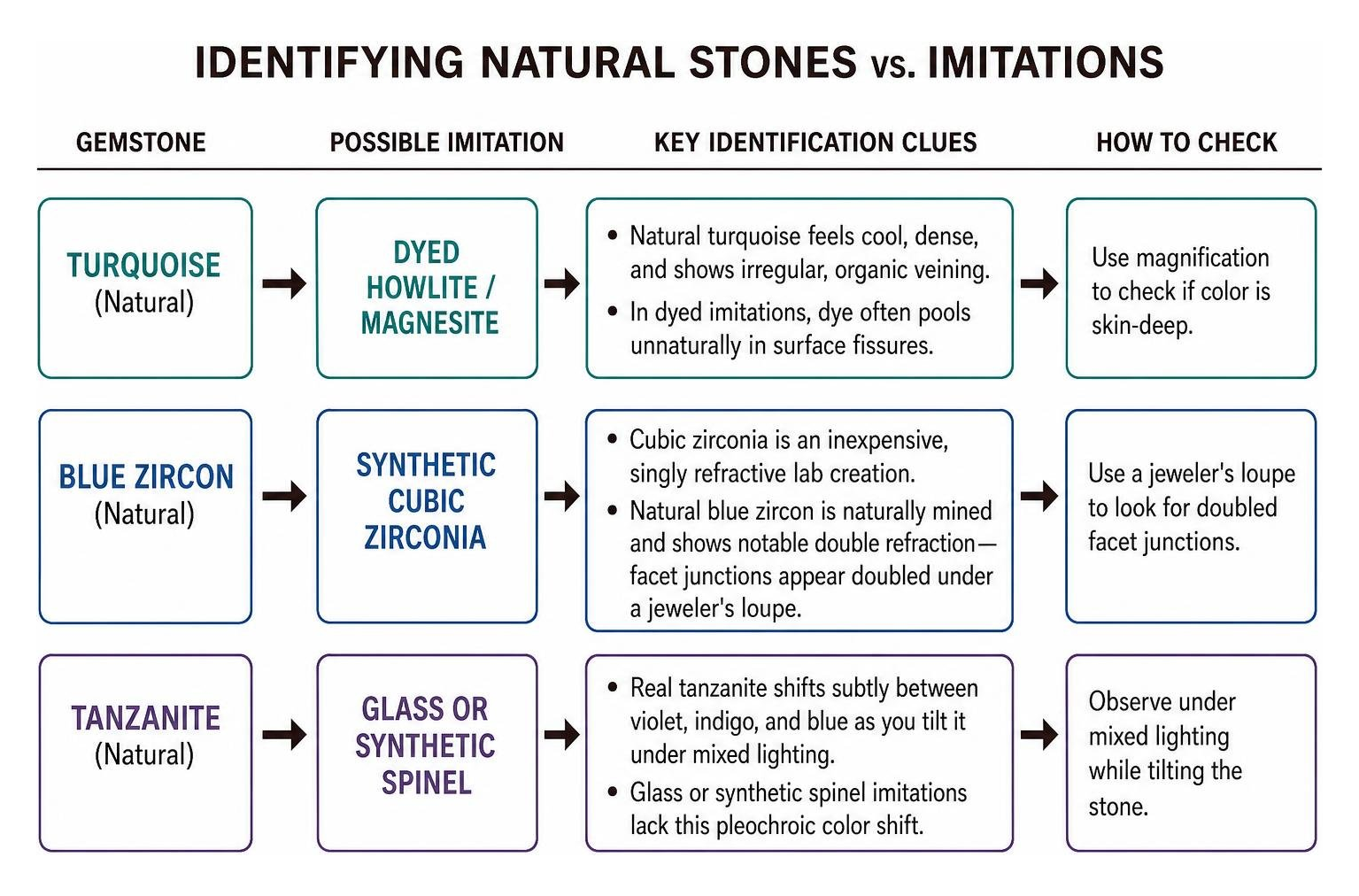
- Turquoise vs. Dyed Howlite/Magnesite: Natural turquoise feels cool, dense, and displays irregular, organic veining. In dyed imitations, dye often pools unnaturally in surface fissures. A magnification check easily reveals whether the color is skin-deep.
- Natural Zircon vs. Synthetic Cubic Zirconia: Despite the phonetic similarity, these materials are completely unrelated. Cubic zirconia is an inexpensive, singly refractive lab creation. Natural blue zircon is a naturally mined crystal featuring notable double refraction, meaning facet junctions appear doubled under a jeweler's loupe.
- Tanzanite Verification: Real tanzanite shifts subtly between violet, indigo, and blue as you tilt it under mixed lighting conditions. Glass or synthetic spinel imitations lack this pleochroic color shift.
Caring for Your December 14 Gemstones
Because December gems range from moderate to delicate on the Mohs hardness scale, adopting proper care habits protects your fine pieces for years to come.
- Turquoise (Mohs 5–6): Being porous, natural turquoise absorbs liquids. Keep it away from perfume, hairspray, lotions, and household detergents. Never submerge turquoise in an ultrasonic cleaner or blast it with steam. Clean it gently with a soft cloth dampened with warm water and mild soap, then pat it dry.
- Tanzanite (Mohs 6–7): Tanzanite is sensitive to sudden thermal shock, which can cause internal fractures. Avoid wearing tanzanite during high-impact sports, yard work, or dishwashing. Skip ultrasonic cleaners in favor of warm water, gentle dish soap, and a very soft brush.
- Blue Zircon (Mohs 6–7.5): While durable, zircon's facet edges can be brittle and prone to chipping if knocked against hard surfaces. Store zircon jewelry in separate fabric-lined pouches so harder gems, like diamonds, do not abrade the surface.
How to Select and Style December Birthstones
For those born under the December 14 Sagittarius sun, selecting jewelry is about honoring an adventurous, independent spirit. Sagittarius is a fire sign, and pairing cool blue gemstones with warm 14k or 18k yellow gold creates a striking contrast between fiery ambition and cool composure. Setting these blue gems in white gold or platinum emphasizes an icy, modern winter aesthetic.
If you enjoy unique jewelry designs, consider multi-stone pieces that harmonize complementary colors. For example, pairing the soft green-blue tones of turquoise with rich February birthstone jewelry accents creates an unexpected, artful contrast. The vivid purple seen in our amethyst: the February birthstone features creates a bold color block when set near the rich violet tones of tanzanite. Exploring creative concepts through dedicated birthstone gifts allows you to curate something genuinely one-of-a-kind.
How to Choose the Perfect Birthstone December 14 Jewelry Gift
When selecting a birthday surprise or milestone anniversary gift for someone born on December 14, consider how the piece fits into their wardrobe:
- For the Free Spirit: Choose turquoise set in smooth bezels or sculptural pendants. Its organic matrix patterns make every piece distinct, suited for relaxed, casual elegance.
- For the Modern Classic: Opt for fine tanzanite earrings or a halo cocktail ring. The shifting blue-violet color makes it a natural centerpiece for evening attire and celebrations.
- For the Sparkle Enthusiast: Blue zircon offers dynamic optical fire. In bezel-set drop necklaces or protected ring designs, zircon delivers vibrant brilliance that catches the light from across the room.
Frequently Asked Questions About December 14 Birthstones
Is blue topaz an official birthstone for December 14?
While turquoise, tanzanite, and zircon are the three primary gems recognized by major organizations like the American Gem Trade Association, blue topaz—especially rich London blue topaz—is widely embraced as a popular modern alternative. It offers a cool blue hue alongside higher Mohs hardness (8.0), making it a practical option for everyday ring wear.
Which December 14 birthstone is the most durable for daily wear?
Blue zircon offers the highest scratch resistance on the Mohs scale (up to 7.5), though its facet edges can be prone to chipping if struck hard. For daily, worry-free wear in rings, protective bezel settings that cover the gem's perimeter are recommended. For delicate stones like turquoise and tanzanite, pendants and earrings provide safe placements away from daily impact.
What is the spiritual meaning of being born on December 14?
People born on December 14 fall under the sign of the Archer, celebrated for their honesty, enthusiasm, and love of exploration. The calming blues of their birthstones help balance intense fire-sign energy, providing tranquility, clear communication, and grounded wisdom during life's many journeys.
Conclusion
Whether you are drawn to the rich history of turquoise, the single-source rarity of tanzanite, or the ancient brilliance of blue zircon, the gemstones of December 14 allow for meaningful personal expression.
At John Atencio, every design begins with a hand-drawn sketch and is crafted using responsibly sourced gemstones and recycled precious metals. We believe jewelry should be wearable art that reflects your personal journey. For domestic in-stock deliveries, John Atencio typically ships via FedEx 2-day service to ensure your piece arrives safely. Please note that John Atencio only ships internationally to Canada at this time.
Explore our curated birthstone guide to find an inspired design that honors your December 14 milestone.