
Embrace Vintage Luxury with Art Deco Emerald Engagement Rings

Why Art Deco Emerald Engagement Rings Stand Out
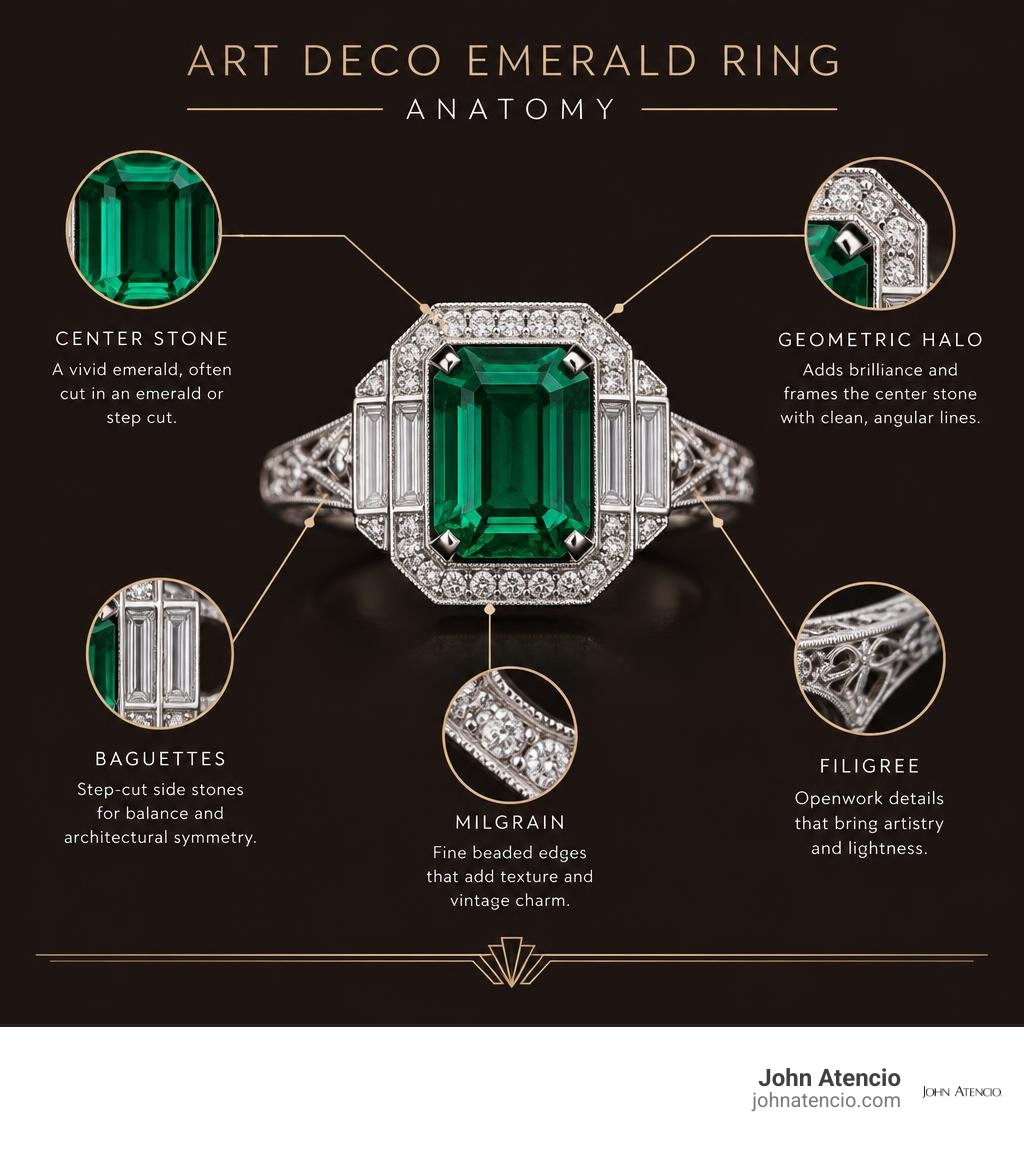
Art Deco emerald engagement rings pair a vivid green center stone with the crisp geometry of the 1920s and 1930s. Look for an emerald-cut or other step-cut emerald, balanced side stones, and details such as a bezel frame, milgrain edges, or open filigree. The result is a bold ring with architectural symmetry, not a generic solitaire.
Emeralds bring rich color and personal meaning to a style known for contrast, clean lines, and confident design. Whether you choose a true vintage piece or a newly made ring inspired by the era, prioritize a protective setting, quality craftsmanship, and a stone whose natural inclusions fit your expectations.
John Atencio typically ships via FedEx 2-day service within the United States and does not ship internationally to customers.
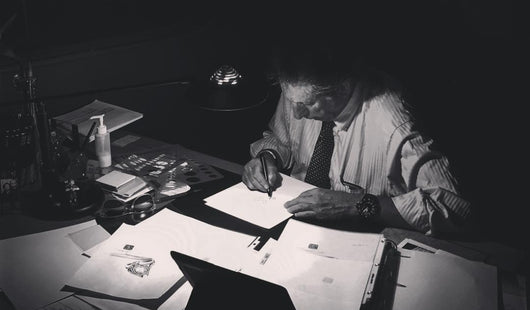
I am Lex Atencio, Executive Vice President at John Atencio, and I help guide the creation of handcrafted jewelry with lasting design value. In this guide, I will explain what to look for in art deco emerald engagement rings, from their defining details to modern customization options.
The Enduring Allure of Art Deco Emerald Engagement Rings
The Art Deco movement emerged during a transformative era defined by rapid industrialization, the exuberance of the Roaring Twenties, and a fresh appetite for bold visual expression. In jewelry design, this translated into an intentional departure from the flowing, nature-inspired curves of earlier periods toward sharp angles, clean contours, and unapologetic color contrast.

At the heart of this aesthetic lies the captivating presence of vibrant emerald gemstones. Throughout history, emeralds have symbolized rebirth, prosperity, and enduring love. When paired with the structural geometry of the 1920s, these lush green stones provide a stunning organic contrast against polished metals and icy accent diamonds.
Historic Origins and 1920s Cultural Influences
The Art Deco movement gained global prominence following the 1925 Exposition Internationale des Arts Décoratifs et Industriels Modernes in Paris. During this vibrant Jazz Age, architecture, fashion, and fine jewelry embraced modernism.
Skyscrapers like the Chrysler Building and the Empire State Building began defining city skylines, inspiring jewelers to craft rings with stepped towers, repeating octagons, and strict architectural symmetry. The era celebrated machine-age precision and daring decorative arts, transforming the engagement ring from a simple token into a sculptural statement of modern luxury.
Why Emeralds Defined the Art Deco Era
Emeralds occupied a position of extraordinary prestige throughout the 1920s and 1930s. Master jewelers sought dramatic color blocking, frequently pairing deep green emeralds with sparkling white diamonds, dark onyx, or rich blue sapphires.
The gemstone's natural crystal habit lent itself beautifully to step-cut faceting. Understanding emerald cut characteristics reveals why this shape became iconic: its rectangular outline, truncated corners, and parallel linear facets mirror the stepped motifs celebrated in Deco architecture while showcasing the gemstone's rich, saturated hue. For broader historical context, the Art Deco movement offers a fascinating look at how this design language shaped everything from jewelry to architecture.
Iconic Architectural Elements in Art Deco Settings
Art Deco jewelry is immediately recognizable by its deliberate architectural components. Rather than relying on simple four-prong mountings, Deco rings incorporate structural tiers, sharp octagonal frames, and intricate geometric halos.
One of the most defining characteristics is the use of sculptural bezel settings. A bezel collar traces the perimeter of the stone in solid precious metal, accentuating its geometric silhouette while providing exceptional daily protection for the gemstone's edges.
The Symmetry of Step Cuts and Baguette Accents
Step cuts are fundamental to the Art Deco aesthetic. Unlike the chaotic brilliance of round or brilliant-cut gems, step cuts offer a calm, hall-of-mirrors effect with elongated flashes of light.
When comparing radiant and emerald cuts, the difference in personality is striking. While a radiant cut features brilliant faceting designed for maximum sparkle, the emerald cut emphasizes clarity, rich depth, and clean lines. Flanking an emerald-cut center stone with tapered baguette diamonds or trapezoid side stones creates an elegant tapering effect that draws the eye directly toward the central gem.
Filigree, Milgrain, and Metalwork
The fine metalwork of the Art Deco era elevated jewelry into true wearable art. Platinum became the metal of choice due to its immense strength, allowing jewelers to pierce delicate lace patterns—known as filigree—into the under-gallery without compromising structural integrity.
Milgrain detailing, consisting of tiny beaded borders rolled along metal edges, framed geometric stones with refined texture. Today, designs like the Majesty emerald ring design reinterpret this meticulous craftsmanship using 18-karat white gold and platinum to deliver both historical charm and modern durability.
Comparing Eras: Art Deco vs. Victorian and Edwardian Rings
Understanding the progression of jewelry design highlights why Art Deco remains so distinct compared to the eras that preceded it.
| Era | Timeframe | Core Motifs & Style | Typical Metals | Gemstone & Setting Preferences |
|---|---|---|---|---|
| Victorian | 1837–1901 | Nature motifs, hearts, snakes, floral engravings, romantic symbolism | Yellow gold, rose gold, silver-topped gold | Old mine cut diamonds, pearls, colored gems in cluster settings |
| Edwardian | 1901–1915 | Garlands, bows, lace ribbons, delicate feminine filigree | Platinum, yellow gold | Old European cut diamonds, subtle pastel accents, delicate openwork |
| Art Deco | 1920–1939 | Bold geometry, symmetry, architectural lines, dramatic contrast | Platinum, white gold, two-tone | Step-cut emeralds, baguette diamonds, bezel settings, bold halos |
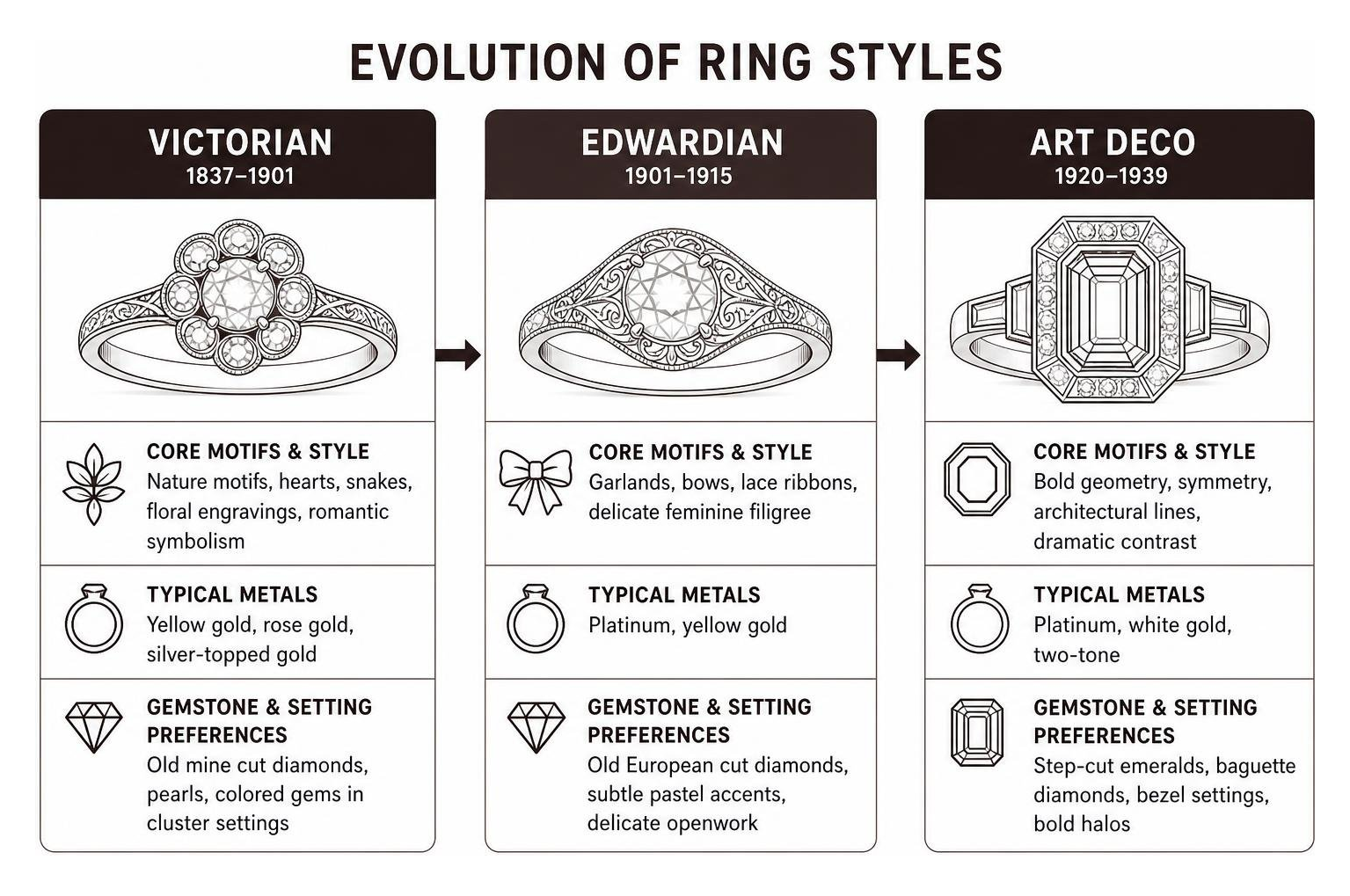
While Victorian jewelry was steeped in sentimental romanticism and Edwardian pieces favored airy, aristocratic lace patterns, Art Deco stripped away the floral flourishes in favor of confident, streamlined geometry.
Sourcing Gemstones for Art Deco Emerald Engagement Rings
Selecting an emerald requires a different approach than choosing a traditional white diamond. Emeralds are Type III gemstones, meaning natural inclusions—poetically referred to as the gemstone's jardin (garden)—are an expected characteristic of their natural formation.
When reviewing an emerald buying checklist, focus on the quality of color first. The ideal stone exhibits an evenly distributed, vivid green hue with strong saturation and medium tone. Inclusions should be distributed in a way that does not threaten the structural durability of the gem or overly diminish its natural transparency. Responsibly sourced natural and fine lab-grown emeralds both offer magnificent avenues to capture this historic look.
Genuine Vintage Heirlooms vs. Modern Art Deco Creations
When shopping for an Art Deco design, buyers often weigh original antique pieces against modern reproductions.
Authentic vintage rings from the 1920s carry genuine historical romance, yet decades of wear can leave prongs thin, filigree brittle, and antique emeralds abraded. In contrast, modern heirloom-quality creations capture the vintage soul while utilizing advanced metallurgy and precision stone-setting techniques for dependable daily wear.
Couples seeking custom bridal jewelry in Denver often choose to craft a custom Art Deco-inspired ring. This allows you to select a pristine center emerald, choose your preferred metal, and tailor every stepped baguette or milgrain edge to your personal aesthetic.
Styling and Customizing Art Deco Emerald Engagement Rings
In 2026, styling an Art Deco emerald ring offers endless creative possibilities. Modern bridal trends embrace mixed-metal bands, combining 18-karat yellow gold shanks with platinum bezel heads to make the green emerald pop dramatically.
Using an interactive Ring Builder, you can pair geometric center stones with custom-fitted chevron wedding bands or geometric diamond jackets that nest seamlessly against the engagement ring’s architectural contours.
Frequently Asked Questions About Art Deco Rings
How do I care for an emerald engagement ring daily?
Emeralds require mindful, gentle care. Clean your ring at home using lukewarm water, mild dish soap, and a very soft-bristled toothbrush. Never clean an emerald in an ultrasonic or steam cleaner, as intense heat and vibrations can damage the stone or remove protective clarity-enhancing oils. Remove your ring before exercising, gardening, or handling household chemicals.
What is the most iconic setting for an Art Deco emerald?
The quintessential Art Deco setting features an emerald-cut center stone secured in a protective platinum or white gold bezel frame, surrounded by a geometric halo of pavé diamonds or flanked by step-cut tapered baguette diamonds with milgrain edge detailing.
Are emeralds durable enough for everyday engagement wear?
Emeralds rank 7.5 to 8 on the Mohs hardness scale, making them durable for daily wear when set in a protective mounting. Choosing a bezel setting or a low-profile halo safeguards the gemstone's corners from accidental impacts.
Conclusion
Art Deco emerald engagement rings remain a pinnacle of fine jewelry design, uniting historic architectural glamour with the vivid beauty of fine green gemstones. At John Atencio, we bring decades of design passion and master craftsmanship to every piece, hand-crafting wearable art meant to be treasured across generations.
Whether you are seeking a bold geometric statement or an intricately detailed modern heirloom, you can explore trending emerald engagement rings to find the perfect expression of your unique love story. Once a ring is hand-crafted, John Atencio ships orders with reliable FedEx 2-day delivery across the United States. Please note that we only ship internationally to customers in Canada.