
3 Carat Champagne Diamond Ring: The Smart Buyer's Style Manual

Why a 3 Carat Champagne Diamond Ring Stands Out
A 3 carat champagne diamond ring pairs a bold center stone with warm honey, amber, brown, or soft yellow undertones. It is a strong choice for someone who wants an engagement ring with personality rather than the icy-white look of a traditional colorless diamond.
When choosing one, focus on three things:
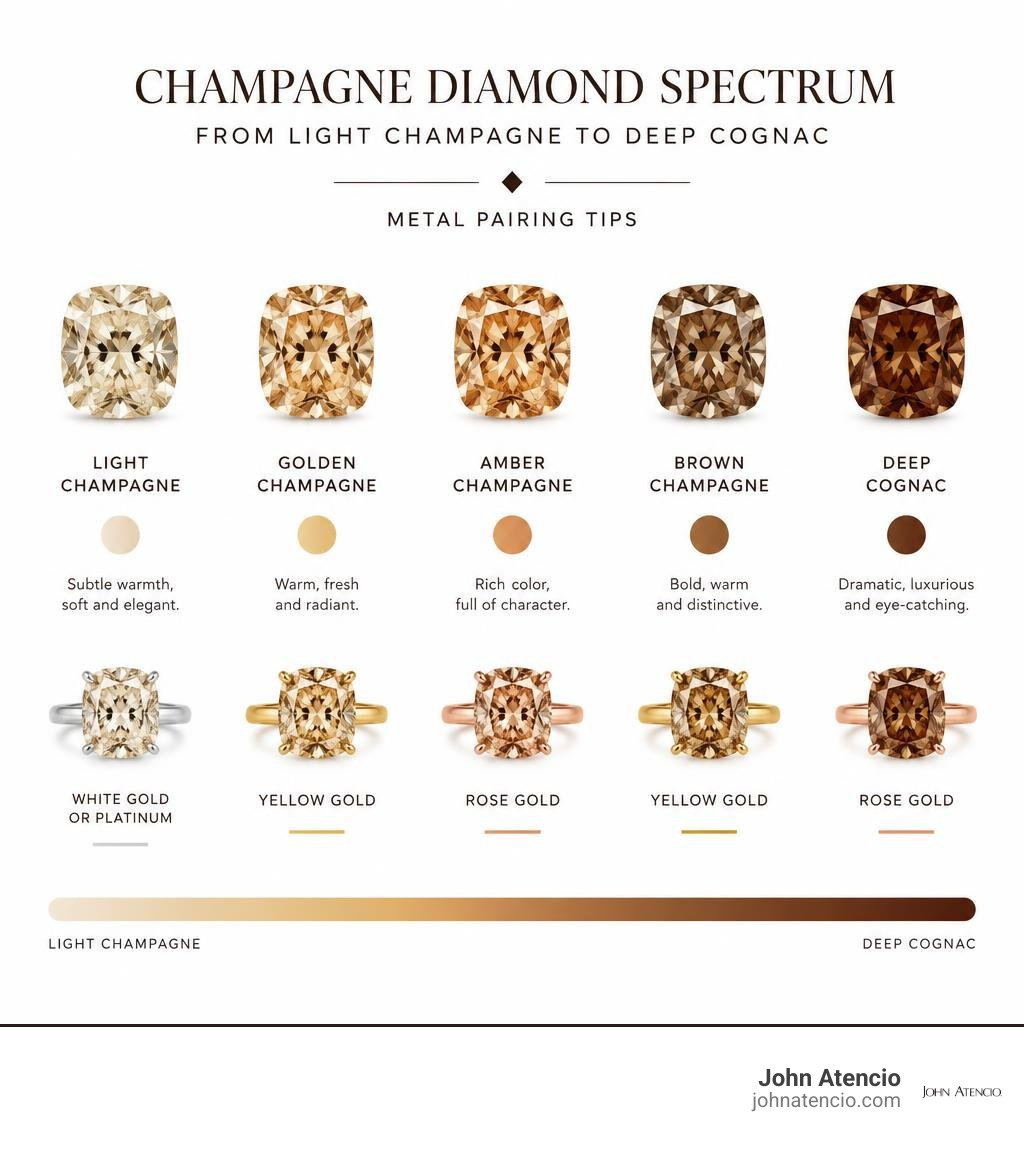
- Color: View the diamond in several lighting conditions. Lighter champagne tones can look subtle, while deeper cognac tones create more contrast.
- Cut: Antique cushions, old-mine cuts, emerald cuts, marquise shapes, and round brilliants each show warm color differently.
- Setting metal: Yellow and rose gold heighten the warmth; white gold or platinum creates crisp contrast.
"Champagne" is a trade term, not a formal GIA grade. These diamonds often fall within the warmer M-Z portion of the color scale, though naturally colored brown diamonds may also be graded outside that range. Their distinctive tone is a major reason warmer diamonds are gaining attention: natural diamond sales in the K-Z range rose 19% in the first quarter of 2026.
At John Atencio, domestic orders typically ship via FedEx 2-day service; international shipping is not available.
I am Lex Atencio, Executive Vice President at John Atencio, with experience helping clients select handcrafted statement jewelry, including the right 3 carat champagne diamond ring for a personal milestone. Next, let’s look at what gives champagne diamonds their color, rarity, and appeal.
What Defines a Champagne Diamond? Color, Rarity, and Appeal
A champagne diamond is a naturally colored diamond displaying hues ranging from delicate straw and golden peach to rich bronze and deep amber. Unlike classic white diamonds prized for an absolute absence of color, a champagne diamond derives its beauty from warmth.
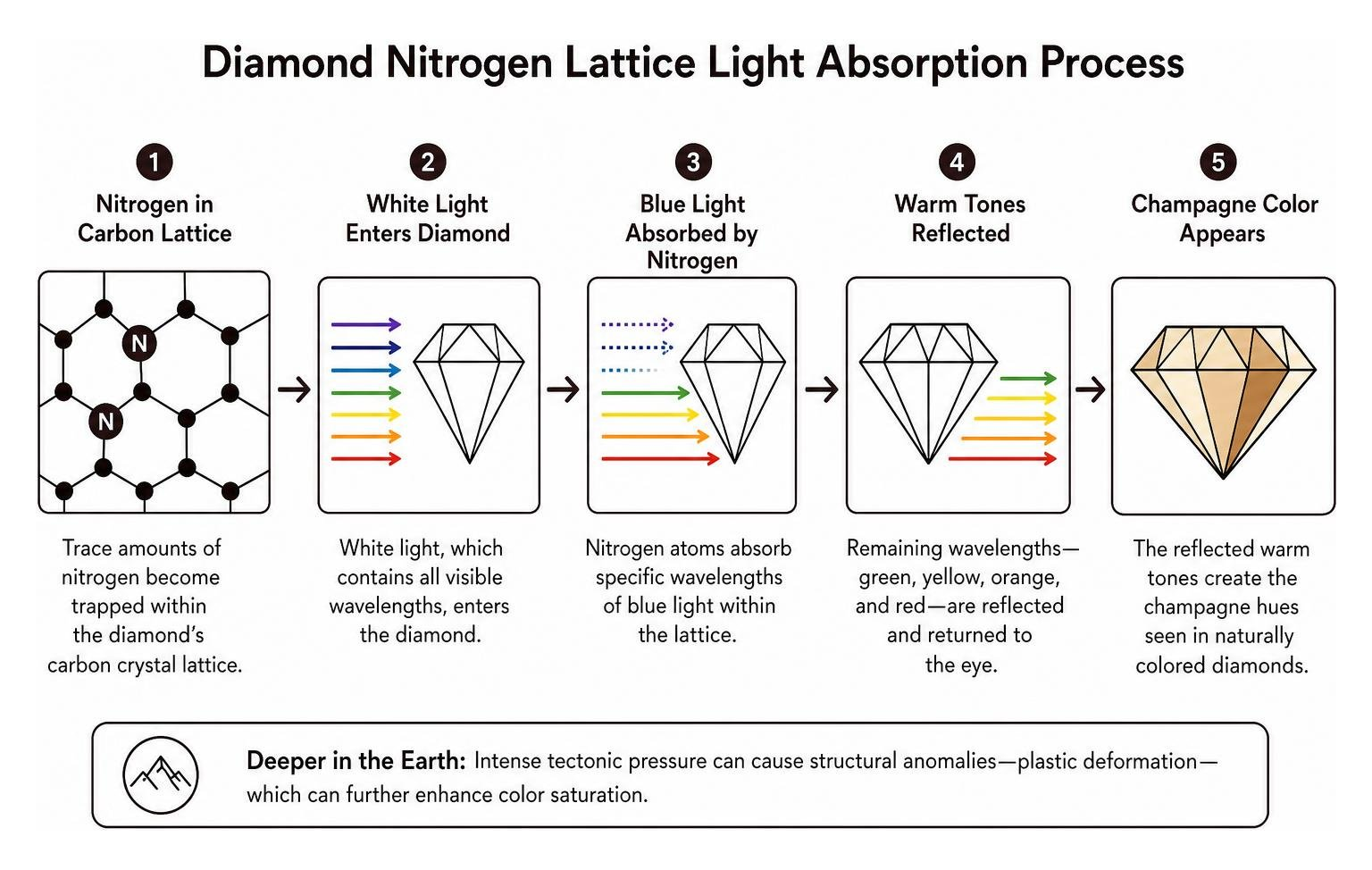
Scientifically, these inviting hues develop deep within the Earth’s mantle over billions of years. Trace amounts of nitrogen trapped within the carbon crystal lattice absorb specific wavelengths of blue light, reflecting golden and brown tones to the human eye. In some instances, structural anomalies caused by intense tectonic pressure—known as plastic deformation—further enrich the stone's color saturation.
While brown diamonds have historically been utilized in creative jewelry pieces, high-quality, gem-grade champagne diamonds with radiant clarity and lively brilliance remain naturally rare. Rather than appearing muted, a well-cut warm diamond yields exceptional light return, casting flashes of amber, bronze, and fiery gold that feel organic, luxurious, and distinctly unconventional.
The M-Z Color Scale and Warm Undertones
When evaluating colored diamonds, understanding standard grading scales helps clarify what makes each stone unique. The Gemological Institute of America (GIA) grades traditional white diamonds from D (colorless) to Z (light yellow or brown). As diamonds progress past the J grade into the K through M range, noticeable warmth begins to appear. Stones falling between M and Z display distinct undertones of fawn, butterscotch, or light champagne.
When brown or yellow coloration exceeds the Z grade in saturation, the stone crosses into the Fancy Color grading territory—classified as Fancy Light, Fancy, Fancy Deep, or Fancy Dark Champagne (often romantically called cognac).
Whether set as an intricate design or featured in a balanced natural champagne diamond three-stone ring, tone saturation dictates the personality of the piece:
- Light Champagne (C1–C2): Subtle, whispering hints of blush, straw, and golden shimmer.
- Medium Champagne (C3–C4): Balanced tones of warm honey, caramel, and vintage toast.
- Dark Champagne / Cognac (C5–C7): Intense, sultry shades reminiscent of aged whiskey, copper, and roasted amber.
Why Choose a 3 Carat Champagne Diamond Ring for Modern Proposals?
Today's couples increasingly prioritize individual storytelling over cookie-cutter aesthetics. The surging interest in warm-toned diamonds reflects a cultural shift toward personal expression and wearable art. With natural diamond sales in the K to Z color range up significantly this year, the allure of warm stones has never been stronger.
A 3 carat center stone provides impressive visual presence and generous finger coverage. At this substantial size—measuring roughly 9.0 mm across in a round cut—a champagne diamond serves as a captivating focal point. It delivers the grandeur of a statement carat weight while exuding an earthy, vintage-inspired elegance that feels effortless rather than ostentatious.
Couples are drawn to this emotional resonance: it feels collected, thoughtful, and artfully tailored to modern romance.
Designing Your 3 Carat Champagne Diamond Ring: Metals, Cuts, and Settings

Designing a mounting for a 3 carat stone requires a thoughtful balance between aesthetic harmony and structural integrity. A substantial gem demands secure architectural support, whether nestled within protective bezel settings or suspended gracefully by sculpted prongs.
Complementary Precious Metals: Yellow, Rose, and White Gold
The choice of precious metal serves as the canvas for your center stone, dramatically altering how its undertones are perceived:
- 18K Yellow Gold: Wrapping a champagne diamond in rich 18-karat yellow gold creates a seamless, monochromatic warmth. The golden alloy magnifies the stone’s amber highlights, evoking an antique, sun-drenched feel.
- 14K Rose Gold: The copper alloys in rose gold pull out soft blush and peach undertones within the diamond. This pairing is romantic, distinctive, and exceptionally flattering across diverse skin tones.
- Platinum and White Gold: Crisp white metals offer dramatic visual contrast. Surrounding a warm center stone with cool platinum creates an intentional counterpoint that makes the diamond's golden body color pop.
- Two-Tone Architecture: Using white gold or platinum prongs on a yellow gold band—or framing a warm center stone with white diamond accents—offers the best of both worlds, blending architectural depth with vibrant contrast.
Selecting the Ideal Cut: Emerald, Marquise, and Antique Shapes
The diamond cut determines how light moves through the crystalline structure, directly influencing color concentration:
- Antique and Old-Mine Cuts: Characterized by high crowns, small tables, and open culets, old-mine and antique cushion cuts celebrate warmth. Their broad facet patterns produce soft, romantic bursts of fire that pair naturally with champagne hues.
- Emerald Cuts: Step-cut stones behave like tranquil halls of mirrors. An emerald cut highlights color purity and clarity rather than chaotic sparkle. When evaluating this sophisticated silhouette, consulting our emerald cut engagement ring checklist ensures you select an exquisite length-to-width ratio and crystal structure.
- Marquise Cuts: The elongated, regal marquise concentrates color slightly toward its tapered points, lending dynamic depth to warm stones. Discover how setting architecture protects these vulnerable tips in our guide to the diamond ring marquise setting.
- Round and Oval Brilliants: Modern brilliant faceting breaks up light into hundreds of tiny scintillations, creating maximum brilliance while dispersing warmth evenly across the entire surface of the gem.
Evaluating the 4Cs and Value Factors for Large Warm Diamonds
Selecting a 3 carat diamond involves navigating the traditional 4Cs—Color, Clarity, Cut, and Carat Weight—with an eye tailored specifically toward colored stones.
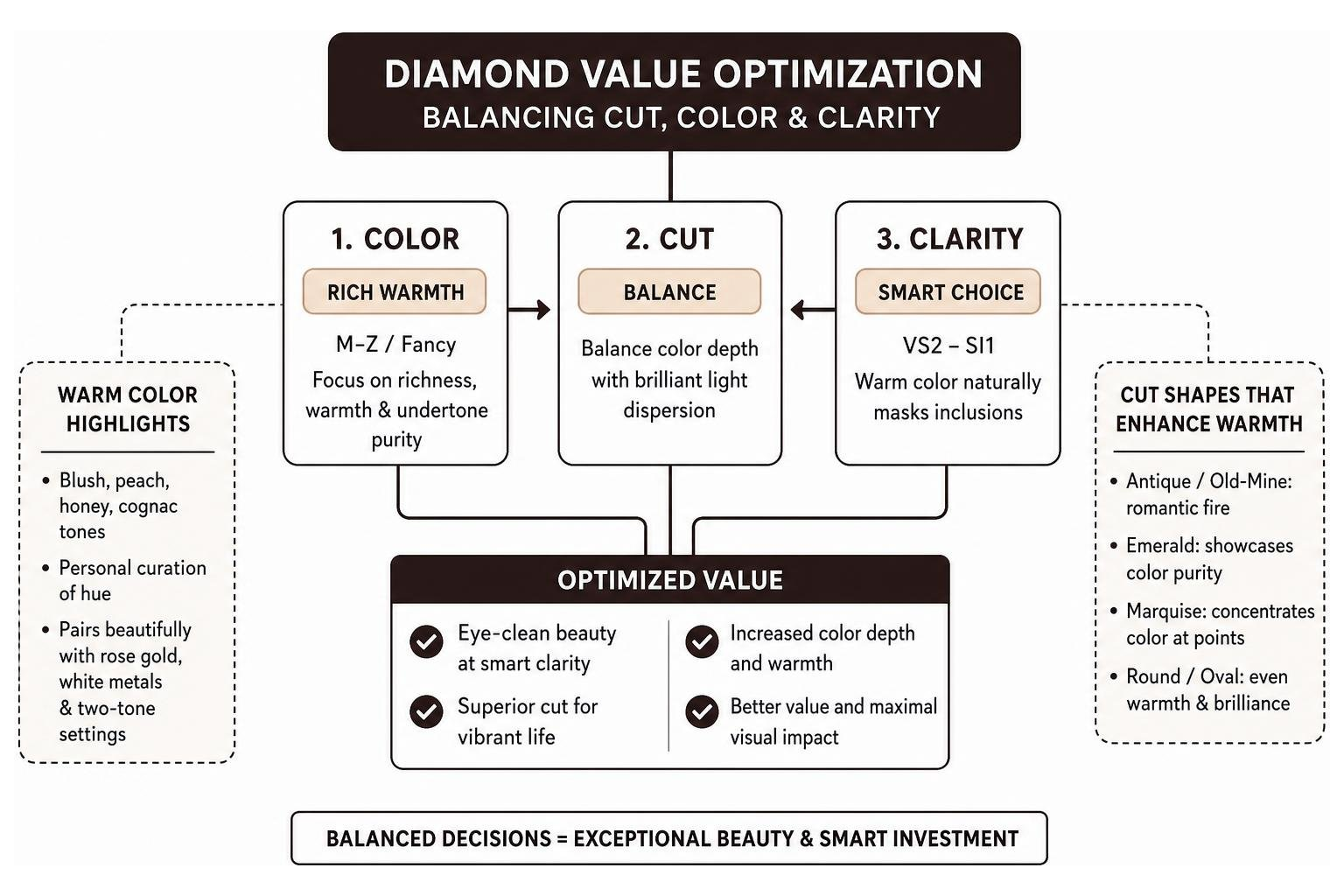
| Characteristic | Colorless Diamond (D–F) | Champagne Diamond (M–Z / Fancy) | Buyer Impact & Benefit |
|---|---|---|---|
| Color Focus | Absolute absence of tint | Richness, warmth, and undertone purity | Allows personal curation of hue (honey, peach, cognac) |
| Clarity Sweet Spot | VS1 – VVS2 (inclusions easily visible) | VS2 – SI1 (warm tint naturally masks inclusions) | Maximize budget toward size and artistic mounting |
| Cut Priority | Maximizing white light return | Balancing color depth and brilliant light dispersion | Shapes like antique cushions and emerald cuts excel |
| Carat Spread | Standard mm dimensions | Standard mm dimensions (approx. 9.0 mm for 3ct round) | Substantial finger coverage with distinctive luxury presence |
Balancing Color Saturation and Clarity
One of the great advantages of warm-toned diamonds lies in their innate ability to mask microscopic natural inclusions. While an inclusion in an icy D-color stone can be easily spotted, the rich body color and golden facet reflections of a champagne diamond naturally camouflage minor characteristics.
Consequently, buyers can comfortably target eye-clean clarity grades such as VS2 or SI1 without compromising optical beauty. This dynamic frees up resources to invest in a superior cut grade, ensuring the 3 carat stone displays vibrant life. Understanding these nuances mirrors the pricing dynamics for marquise diamonds, where cut quality and smart clarity choices yield exceptional visual value.
Natural vs. Lab-Grown 3 Carat Champagne Diamond Ring Options
Modern fine jewelry buyers enjoy access to both earth-mined and laboratory-created options:
- Natural Champagne Diamonds: Formed over millions of years deep in the earth, natural stones carry geological history, natural rarity, and heirloom prestige. Their colors reflect organic geological events, resulting in one-of-a-kind color nuances that can never be entirely replicated.
- Lab-Grown Champagne Diamonds: Cultivated using advanced chemical vapor deposition (CVD) or high-pressure high-temperature (HPHT) processes, lab-grown diamonds possess identical physical, chemical, and optical properties to mined diamonds. Choosing lab-grown allows clients to secure a larger carat weight or higher clarity tier while maintaining budget flexibility.
Both paths offer ethical, dazzling centerpieces for custom design; the choice ultimately depends on whether you prioritize geological provenance or maximum physical scale within your target investment range.
Styling and Caring for Your Statement Ring
A 3 carat champagne diamond ring effortlessly bridges the gap between bold high-fashion glamour and grounded, organic styling.
Everyday Wear and Versatile Styling
Unlike traditional white diamonds that can sometimes feel formal against casual attire, the earthy undertones of a champagne diamond lend themselves to effortless daily wear:
- Casual Elegance: Pair your ring with neutral knits, crisp denim, and tailored linen. The warm stone harmonizes beautifully with everyday wardrobe palettes.
- Mixed-Metal Stacking: Enhance the ring's tonal depth by surrounding it with stacked bands in contrasting metals. Flanking a yellow gold champagne solitaire with micro-pavé white diamond eternity bands creates an intentional, layered look.
- Evening Sophistication: Under warm ambient dinner lighting, champagne diamonds come alive, throwing golden embers of light that complement black-tie gowns and evening wear.
Cleaning and Long-Term Maintenance
Preserving the fiery luster of a large diamond requires simple, consistent care:
- Weekly Home Cleanses: Soak the ring in a bowl of warm water mixed with a few drops of mild, degreasing dish soap. Gently brush behind the setting and under the diamond's pavilion with an ultra-soft toothbrush to remove lotions and oils.
- Rinse and Dry: Rinse thoroughly under lukewarm running water (ensure the drain is securely covered!) and pat dry with a lint-free microfiber cloth.
- Ultrasonic Caution: While diamonds are exceptionally tough, rings featuring intricate pavé side stones or vintage filigree should be cleaned in ultrasonic machines only under professional supervision.
- Periodic Inspections: Bring your ring to our artisans twice a year for a prong-tightening inspection and professional steam cleaning to guarantee lifelong security.
Frequently Asked Questions About Champagne Diamond Rings
How much does a 3 carat champagne diamond cost?
The cost of a 3 carat champagne diamond varies based on several core factors: whether the stone is natural or lab-grown, the depth and evenness of its color saturation, its clarity grade, and the complexity of the precious metal mounting. Natural stones in deeper fancy cognac ranges command higher investment levels due to their geological rarity, while lighter champagne hues offer accessible entry points into large-carat styling.
Are champagne diamonds as durable as white diamonds?
Yes, absolutely. A champagne diamond is a genuine diamond, ranking at a perfect 10 on the Mohs scale of mineral hardness. It possesses the exact same structural resilience, scratch resistance, and daily wear durability as any colorless diamond, making it an enduring heirloom for everyday life.
What makes champagne diamonds rarer than traditional diamonds?
While brown is a common color in rough industrial-grade diamond mining, gem-quality champagne diamonds featuring clean crystal clarity and luminous, attractive undertones represent a tiny fraction of global diamond recoveries. Natural colored diamonds account for less than 0.1% of all gem-quality diamonds mined worldwide, making an eye-clean, vibrant 3 carat specimen an uncommon treasure.
Conclusion
A custom engagement ring should be more than a simple piece of jewelry—it should be a wearable sculpture that mirrors your personal narrative and design sensibilities. Whether you are captivated by a soft honey emerald cut or a fiery cognac antique cushion, our team is dedicated to bringing your unique vision to life through architectural craftsmanship and personalized design.
To begin your journey and explore our bespoke bridal creations, discover The Elite 3 Carat Diamond Ring Experience. Every John Atencio design is hand-crafted with meticulous attention to detail, utilizing responsibly sourced materials to ensure your statement piece stands the test of time.
Please note that we fulfill orders within the United States and Canada via complimentary FedEx 2-day shipping. Connect with our master designers today to curate your one-of-a-kind statement ring.

