
Real vs. Faux: The Smart Shopper's Guide to 3 Carat Simulated Diamonds

Is a 3 Carat Fake Diamond Ring Right for You?
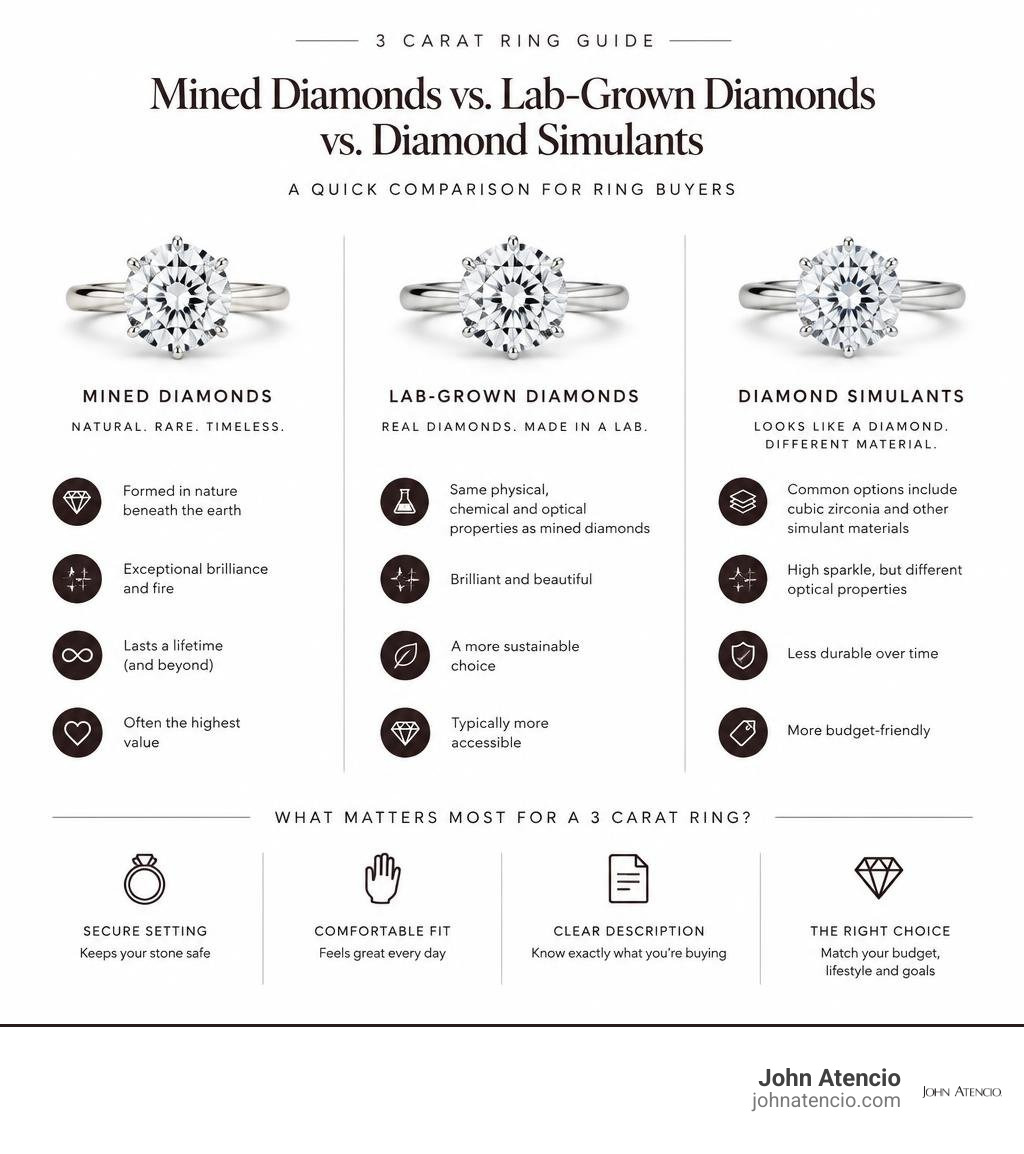
A 3 carat fake diamond ring gives you the look of a large diamond without a mined diamond center stone. Most use cubic zirconia or another diamond simulant. A lab-grown diamond is a different choice: it is a real diamond, made in a lab rather than mined. If you want a ring for travel or a temporary proposal, start with a simulant. If you want a real diamond for long-term wear, compare lab-grown options.
In either case, look beyond sparkle. A stone this large needs a secure setting, a comfortable fit, and a clear description of what you are buying. If you shop with John Atencio, the company typically ships via FedEx 2-day service and does not ship internationally to customers.
I'm Lex Atencio, Executive Vice President at John Atencio. I'll help you assess a 3 carat fake diamond ring by its stone, setting, and fit, starting with the difference between simulants and diamonds.
What Defines a 3 Carat Fake Diamond Ring? Materials and Science
When exploring faux jewelry, terminology matters. Consumers often encounter terms like "diamond simulant," "faux diamond," "diamond veneer," and "artificial diamond" used interchangeably. However, the underlying materials determine how the stone performs, how long it retains its brilliance, and how it feels on your hand.
Cubic Zirconia and Simulant Compositions
The vast majority of faux diamond rings feature cubic zirconia (CZ). Chemically known as zirconium dioxide ($\text{ZrO}_2$), cubic zirconia is a synthesized crystalline material that is hard, optically clear, and virtually free of internal inclusions.
Because cubic zirconia is created in a strictly controlled laboratory environment, manufacturers can produce stones with high clarity and colorlessness. In premium jewelry, top-tier simulants often use 6A-grade cubic zirconia cut with precision facets to maximize light dispersion.
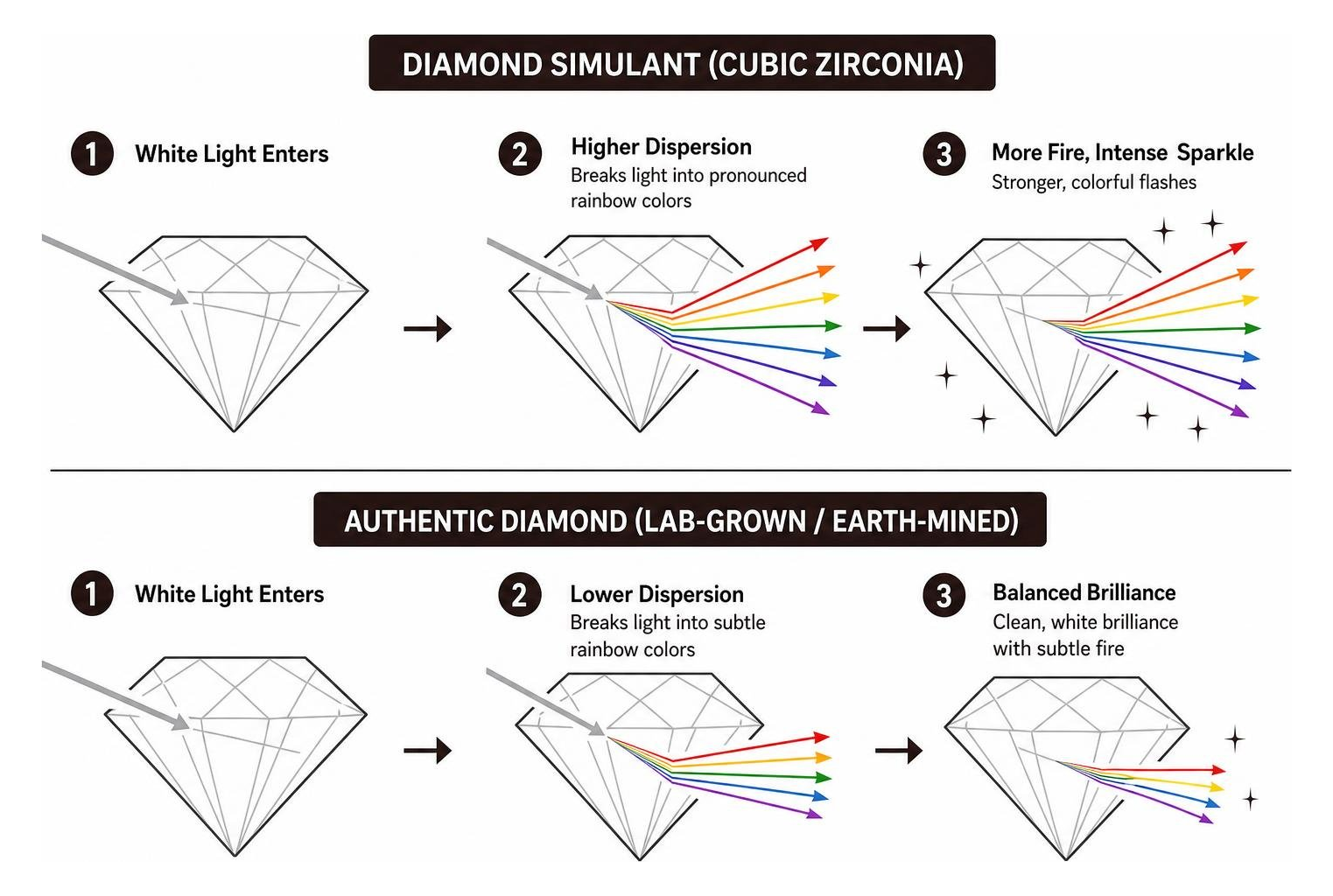
Simulants have a higher optical dispersion than natural diamonds, meaning they break white light down into rainbow flashes ("fire") at a higher rate. While this creates immediate, intense sparkle, it is also one of the telltale visual signatures that distinguishes a simulant from an authentic diamond.
Simulated vs. Authentic Lab-Grown Diamonds
A critical distinction that every jewelry shopper must understand is the difference between a diamond simulant and an authentic lab-grown diamond.
- Diamond Simulants (Cubic Zirconia, Moissanite, Diamond Veneer): These stones merely imitate the look of a diamond. They have entirely different chemical, physical, and optical properties. They do not contain crystallized carbon.
- Lab-Grown Diamonds: These are authentic diamonds. They share the exact same chemical structure (pure carbon arranged in a diamond crystal lattice), physical hardness, thermal conductivity, and optical brilliance as earth-mined diamonds. They test as real diamonds because they are real diamonds.
If you are considering fine jewelry that lasts for generations, exploring lab-grown diamond engagement rings provides authentic diamond performance with exceptional quality. For a broader scientific overview of diamond simulants, the Diamond simulant entry on Wikipedia explains how materials like cubic zirconia differ from crystallized carbon.
| Feature | Cubic Zirconia (Simulant) | Lab-Grown Diamond | Earth-Mined Diamond |
|---|---|---|---|
| Chemical Composition | Zirconium Dioxide ($\text{ZrO}_2$) | Pure Crystallized Carbon ($\text{C}$) | Pure Crystallized Carbon ($\text{C}$) |
| Mohs Hardness | 8.0 – 8.5 | 10 | 10 |
| Refractive Index | 2.15 – 2.18 | 2.42 | 2.42 |
| Dispersion (Fire) | 0.058–0.066 (High rainbow flash) | 0.044 (Balanced brilliance) | 0.044 (Balanced brilliance) |
| Thermal Conductivity | Thermal Insulator | Exceptional Conductor | Exceptional Conductor |
| Longevity | Prone to scratching/clouding | Permanent heirloom durability | Permanent heirloom durability |
Visual Comparison: How Faux Stones Compare to Mined Diamonds
At three carats (approximately 9.5 mm in diameter for a round brilliant cut), a gemstone commands attention. In the United States, any center stone over two carats is considered significantly large. Because of this substantial surface area, the optical differences between simulants and authentic diamonds become much easier to spot.
Evaluating Cut Quality in a 3 Carat Fake Diamond Ring
Cut is the single most important factor determining a gemstone’s brilliance. In genuine high-grade diamonds, the prestigious Hearts & Arrows (H&A) pattern is found only in the top 1% of round brilliant cuts, requiring exact facet angles and optical symmetry.
Higher-end simulated rings now incorporate precision Hearts & Arrows facet geometry into cubic zirconia. When a faux stone is cut with exact optical symmetry:
- Light Return: Maximizes the brightness reflected back to the viewer's eye.
- Contrast: Balances bright white flash with darker pattern reflections for a crisper appearance.
- Facet Sharpness: Prevents the "glassy" or rounded facet edges common in low-cost fashion jewelry.
Color, Clarity, and Everyday Durability
Most 3-carat simulants are manufactured to mimic an absolute D-color (completely colorless) and Internally Flawless (IF) clarity grading. While a natural D/IF diamond of this size represents an ultra-rare luxury tier, simulated stones achieve this look synthetically.
However, the primary difference lies in everyday durability:
- Surface Porosity and Clouding: Cubic zirconia is softer (8.0 to 8.5 on the Mohs scale) and slightly porous compared to diamond. Over time, contact with body oils, lotions, hand soaps, and microscopic airborne dust creates fine micro-scratches on the surface facets, resulting in a cloudy look that cannot be cleaned away.
- Scratch Resistance: Diamonds rate at 10 on the Mohs hardness scale—making them the hardest known natural substance. A diamond resists scratching from virtually every daily material, retaining its crisp facet junctions and glass-clear polish for a lifetime.

Popular Settings, Metals, and Sizing for Large Center Stones
A substantial 3-carat gem requires thoughtful architectural design. At John Atencio, we treat fine jewelry as wearable art, where the structural metalwork must balance and protect the center stone while feeling effortless on the finger.
Band Metals and Hypoallergenic Settings
Because faux stones span a wide range of price tiers, they are set in everything from entry-level plated base metals to solid fine gold. When selecting a band, consider skin sensitivities and long-term durability:
- Sterling Silver (.925) with Rhodium Plating: A popular choice for travel rings. High-grade rhodium plating prevents tarnishing, adds a brilliant mirror shine, and shields skin from nickel allergies.
- Solid 14K or 18K Gold: Fine gold settings (available in white, yellow, and rose gold) ensure structural strength, meaning prongs won't bend or release your stone unexpectedly.
- Platinum: The densest and most secure metal for large stones, offering natural hypoallergenic properties and unmatched prong security.
If you appreciate bold, sculptural geometry, our modern unique engagement rings demonstrate how premium precious metals elevate large-carat proportions.
Setting Styles for a 3 Carat Statement
Large center gems exert distinct visual weight. Choosing the right setting style ensures the stone looks balanced and remains safe during daily activities:
- Classic Solitaire: Keeps the focus entirely on the center stone. Six-prong settings offer added security over four-prong styles for stones of this magnitude.
- Protective Bezel Setting: A sleek metal rim encases the perimeter of the stone, shielding the girdle from accidental impacts and eliminating snagging prongs entirely.
- Three-Stone Setting: Flanking a 3-carat stone with side baguettes, pears, or rounds distributes visual finger coverage smoothly across the hand.
- Distinct Fancy Shapes: Exploring alternatives to round cuts—such as the Pure 3 carat oval lab diamond engagement ring or the clean architectural lines of the Lumen 3 carat radiant lab diamond engagement ring—gives a bold, modern edge to large-carat styling.
Sizing and Balance for Large Carat Rings
A 3-carat stone sits higher off the finger and carries noticeable top weight. If your band is not sized with precision, the ring will pivot or "spin" uncomfortably to the side.
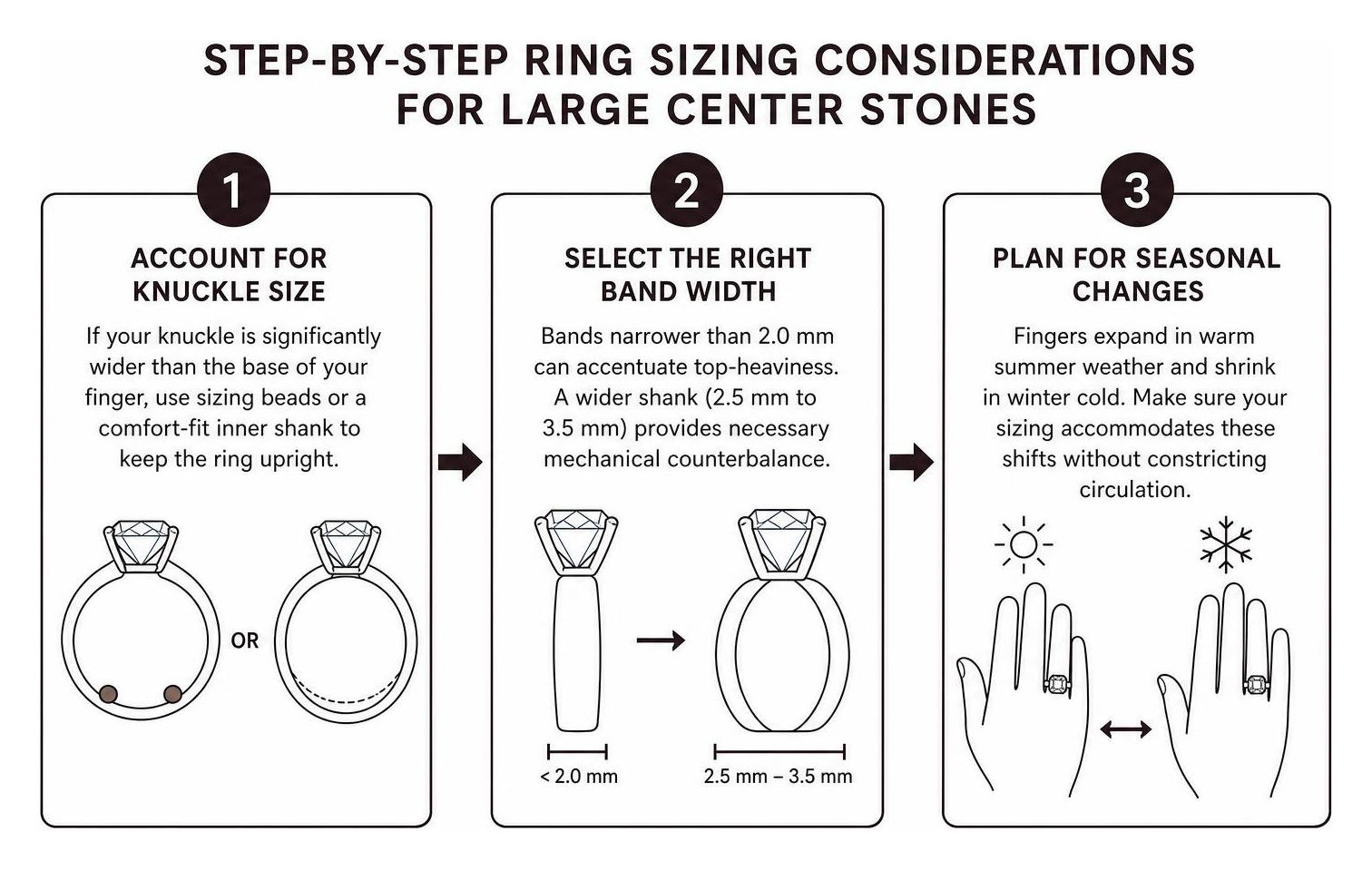
- Account for Knuckle Size: If your knuckle is significantly wider than the base of your finger, use sizing beads or a comfort-fit inner shank to keep the ring upright.
- Select the Right Band Width: Bands narrower than 2.0 mm can accentuate top-heaviness. A wider shank (2.5 mm to 3.5 mm) provides necessary mechanical counterbalance.
- Plan for Seasonal Changes: Fingers expand in warm summer weather and shrink in winter cold. Make sure your sizing accommodates these shifts without constricting circulation.
Key Benefits and Strategic Buying Use Cases
Why do shoppers gravitate toward simulated 3-carat rings? For many, faux diamond options serve specific lifestyle and strategic purposes.
Why Choose a 3 Carat Fake Diamond Ring for Travel or Proposals?
- The Stress-Free Travel Ring: Traveling abroad with an expensive family heirloom or high-value diamond can bring unnecessary anxiety regarding theft or loss. A simulated ring allows you to enjoy dramatic sparkle on vacation while leaving your fine jewelry safely locked at home.
- The Surprise Placeholder Ring: Proposing is a deeply personal milestone. If you want the romance of a surprise proposal but prefer your partner to choose or design their forever setting, a 3-carat simulant serves as an exciting temporary stand-in.
- Test-Driving Carat Size: Wearing a 3-carat simulated stone for several weeks helps you discover whether a large profile suits your daily lifestyle, wardrobe, and work environment before committing to fine 3-carat diamond rings.
Price Comparison and Ethical Advantages
A natural, untreated 3-carat diamond boasting top D–E color, flawless clarity, and precision optical cut represents a substantial financial commitment that often reaches well into six-figure territory.
Simulated stones and lab-grown diamonds present distinct alternatives across the budget spectrum:
- Simulated Stones: Offer an accessible visual placeholder for temporary or costume wear.
- Authentic Lab-Grown Diamonds: Provide the permanent beauty, optical purity, and heirloom longevity of a genuine diamond, backed by fully traceable, conflict-free origins and modern technological innovation.
Smart Buyer Checklist: Warranties, Sizing, and Quality Verification
Before purchasing a large faux or lab-grown ring, run through this practical quality checklist:
Quality Verification and Return Policies
- Inspect Facet Reflections: Look at the stone under indirect natural daylight. If the center looks milky or throws excessive orange-red glare compared to white brilliance, the cut quality or material density is low.
- Check the Girdle Edge: Quality stones feature polished or faceted girdles rather than rough, frosted edges.
- Understand the Fine Print on Returns: Many online retailers charge substantial restocking fees (sometimes 15% to 35%) on returned rings, or limit returns to store credit. Verify that you have an open inspection window to view the piece in person.
- Review Warranty Coverage: Check whether the seller guarantees stone replacement if the simulant scratches or chips under normal wear.
When you are ready to explore lasting fine jewelry with bold silhouettes, our handcrafted designs—such as the Lumen 3 carat marquise lab diamond engagement ring—combine structural integrity with master-level diamond setting.
Frequently Asked Questions About Simulated Diamond Rings
Will a 3 carat simulated diamond look fake on the hand?
Because a 3-carat stone measures roughly 9.5 mm across, its optical properties are easily visible. In direct sunlight, cubic zirconia produces strong rainbow flashes (high dispersion) that differ from the balanced white light and scintillation of a natural or lab-grown diamond. A high-precision cut like Hearts & Arrows helps minimize this effect, but trained observers can typically tell the difference under close inspection.
How do I clean and care for a cubic zirconia ring?
Clean your ring using warm water, mild liquid dish soap, and an extra-soft toothbrush. Gently brush behind the setting where hand lotions and oils collect. Avoid harsh abrasive cleaners, chemical dips, and steam cleaners, which can erode rhodium plating and dull simulant surfaces over time. Always pat dry with a clean microfiber cloth.
What is the price difference between simulated, lab-grown, and mined 3 carat rings?
Simulated rings represent the most affordable tier, with prices determined primarily by the mounting metal (ranging from silver to solid gold). Lab-grown diamonds occupy a middle tier, delivering an authentic diamond experience at an accessible point. Mined diamonds of comparable 3-carat size and premium cut/clarity command the highest market valuations due to their geological rarity.
Conclusion
Choosing the right ring comes down to your personal lifestyle, values, and long-term vision. A simulated ring provides an exceptional, stress-free option for travel, milestone placeholders, and trend-focused statement wear.
When you decide to transition from a temporary piece to an enduring heirloom, John Atencio brings five decades of distinctive design expertise to every creation. Whether you want to select an artfully balanced mounting or collaborate design, our team ensures every diamond is set with uncompromising integrity.
To explore fine center stones, settings, and bespoke styling, discover the elite 3-carat diamond ring experience with John Atencio and find the piece that tells your unique story.

