
Find Your Ideal 14k Yellow Gold Engagement Ring Without Compromising on Quality

How to Choose a 14k Yellow Gold Engagement Ring
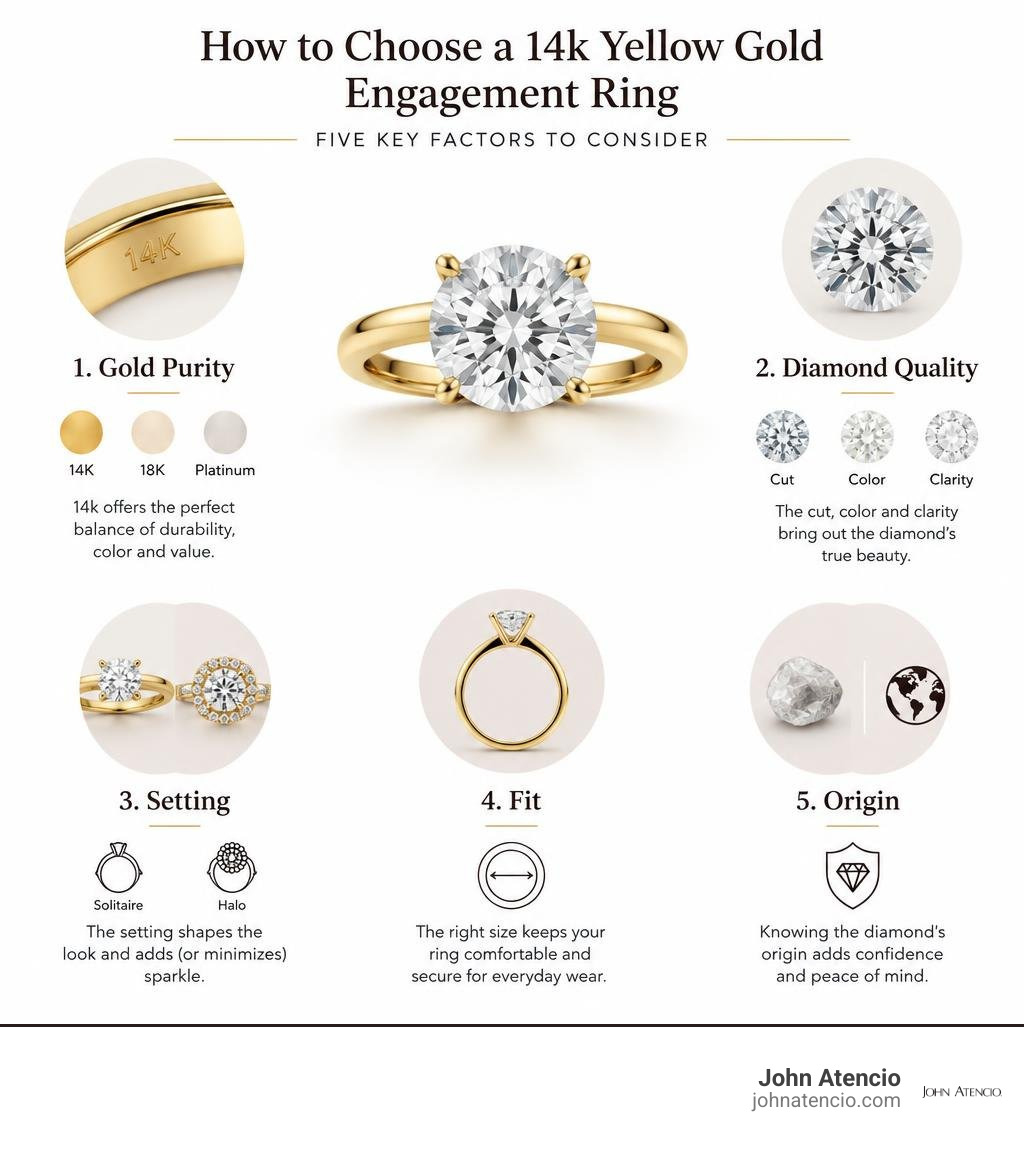
14k yellow gold engagement rings balance warm color, everyday durability, and a lower metal cost than 18k gold. To compare them, look beyond carat weight: check the diamond's cut, color, and clarity, then consider the setting, ring size, and what the jeweler can tell you about the diamond's origin. A halo adds sparkle around the center stone; a solitaire puts that stone in the spotlight. For broader context on how gold alloys are standardized across fine jewelry, the gold overview from Wikipedia explains purity, karatage, and alloying in detail.
If you're shopping with John Atencio, note that in-stock and completed custom orders typically ship via FedEx 2-day service.
I'm Lex Atencio, Executive Vice President at John Atencio Jewelry. I draw on my work in fine jewelry to help you compare 14k yellow gold engagement rings with confidence.
Why Choose 14k Yellow Gold Engagement Rings?
Choosing an engagement ring is an emotional and aesthetic journey, but it is also a masterclass in materials science. In 2026, the renaissance of yellow gold is stronger than ever. Couples are gravitating away from cooler white metals to embrace the rich, radiant warmth of natural gold.
When you explore gold engagement rings for women, 14-karat yellow gold stands out as the ultimate sweet spot. Pure 24-karat gold is naturally dense, velvety, and yellow, but it is far too soft to secure precious gemstones over decades of daily activity. To create jewelry that withstands real life—from gym sessions to office keyboards—pure gold is alloyed with durable metals such as copper, silver, and zinc.
A 14k alloy consists of 58.3% pure gold combined with 41.7% alloy metals. This specific formula delivers exceptional tensile strength, remarkable resistance to bending or denting, and an inviting, classic golden glow that complements every skin tone.
| Metal Purity | Pure Gold Content | Relative Hardness | Maintenance Profile | Best Suited For |
|---|---|---|---|---|
| 10k Gold | 41.7% | Very High | Minimal; higher alloy content can cause skin reactions for some | High-impact, heavy-duty wear |
| 14k Gold | 58.3% | High | Low; excellent scratch resistance, no replating needed | Active lifestyles & daily engagement wear |
| 18k Gold | 75.0% | Moderate | Low-to-Moderate; richer hue, softer surface prone to patina | Luxurious feel & traditional fine jewelry |
| Platinum | 90–95% | Dense / Malleable | Moderate; develops a soft patina, requires occasional polishing | Cool-toned preference & maximum density |
Metal Finishes and Durability for 14k Yellow Gold Engagement Rings
The way a ring interacts with light depends heavily on its surface treatment. While a mirror-like high polish finish remains the standard for timeless bridal pieces, textured treatments offer distinct character and practical benefits.
A 14k yellow gold satin polish finish introduces a soft, brushed luster that diffuses light across the metal's contours. This finish gracefully masks micro-abrasions that naturally occur over time, making it an inspired choice for individuals with hands-on careers or active lifestyles. When paired with contoured wedding bands, contrasting or matching metal finishes can create a deeply personalized bridal stack that tells a distinct visual story.
Comparing 14k Yellow Gold’s Durability, Color, and Value
Beyond structural integrity, 14k yellow gold provides substantial peace of mind. Unlike white gold, which relies on a rhodium plating that gradually wears away and requires periodic reapplication, yellow gold holds its authentic color permanently. Its natural hue never fades, chips, or alters over time.
Financially, 14k gold maximizes your overall investment. Because it utilizes 58.3% pure gold rather than the 75% found in 18k alloys, it provides a high-end, solid-gold heirloom while freeing up a larger portion of your budget for the center gemstone.
Evaluating Diamond Quality: Color, Clarity, and Carat Weight
A gorgeous setting deserves a thoughtfully chosen center stone. Finding harmony between your metal choice and diamond grading ensures you never spend money on technical grades that offer no visible benefit to the naked eye. Exploring how to choose an engagement ring diamond allows you to make informed decisions across the classic 4Cs: Cut, Color, Clarity, and Carat Weight.
Understanding Color Grades: Warm Tones vs. Colorless Accents
Diamond color is graded on an alphabetical scale from D (completely colorless) to Z (light yellow or brown). While colorless stones (D–F) look striking in cool white metals, yellow gold opens up exciting design opportunities.
When learning how to pick a diamond, consider how yellow gold reflects throughout the stone:
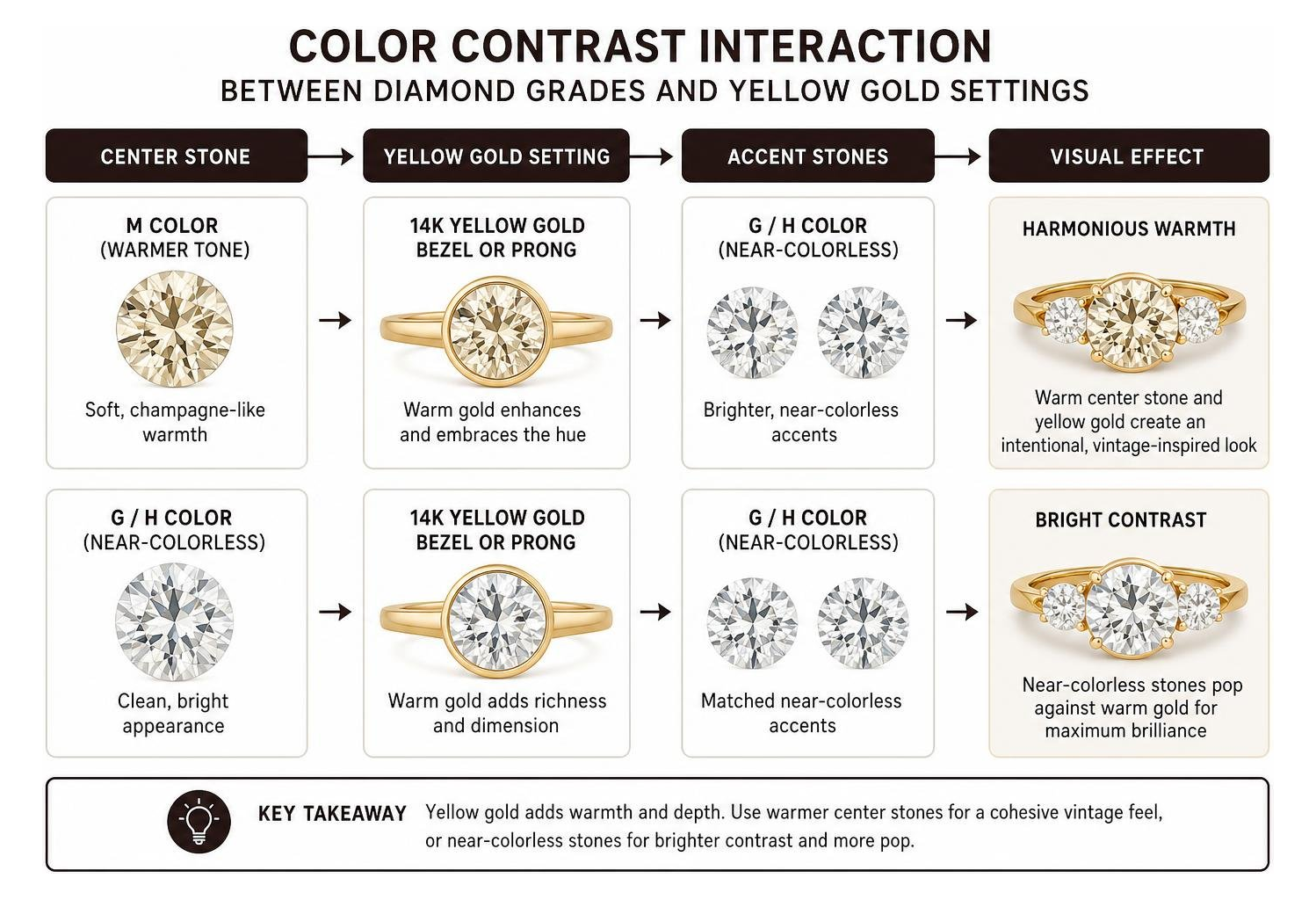
- Warmer Center Stones (M Grade): An M-color diamond possesses a delicate, champagne-like warmth. When nestled inside a warm 14k yellow gold bezel or prong head, this soft hue appears intentional and vintage-inspired rather than tinted, offering an elegant aesthetic.
- Contrasting Colorless Accents (G/H Grade): Surrounding a warmer center stone with near-colorless G/H accent diamonds creates an artistic, multi-dimensional contrast. The brighter side stones frame the center, making the ring pop from across the room.
Clarity and Carat Weight: From SI2 Inclusions to Total Diamond Weight
Diamond clarity measures the presence of internal characteristics (inclusions) and surface blemishes. An SI2 (Slightly Included 2) grade indicates that inclusions are visible under 10x magnification, but often difficult to detect with the unaided eye—especially when well-positioned beneath prongs or facets. Choosing an eye-clean SI2 diamond provides exceptional value, allowing you to prioritize diamond size or intricate band detailing.
Consider how carat weight distributes across a design:
- A 0.46-carat center diamond offers a refined footprint on the finger, balancing noticeable presence with wearable comfort.
- Adding 26 round accent diamonds (0.19 total carat weight) forms a glittering frame that expands the ring's overall visual diameter, delivering the commanding brilliance of a much larger single stone.
Ring Architecture: Settings, Styles, and Sizing Considerations
The structural design of your ring dictates both its aesthetic silhouette and its daily durability. Reviewing how to choose an engagement ring setting helps ensure your mounting matches your partner's personal style and daily routine.
Styling 14k Yellow Gold Engagement Rings with Halo and Solitaire Settings
The setting is where personal expression shines brightest:
- Halo Settings: A halo encircles the center stone with a perimeter of micro-pavé diamonds. In our featured design, 26 accent stones wrap around the 0.46ct center gem, significantly amplifying light return and visually expanding the center stone's perceived size. Explore our curated halo engagement rings to see how this architectural technique creates remarkable presence.
- Solitaire Settings: For those who value understated elegance, classic solitaire engagement rings elevate the diamond with zero distractions, relying on clean metal lines and structural balance.
Finding the Proper Ring Size and Fit
An engagement ring should slide smoothly over the knuckle with slight resistance, resting comfortably at the base of the finger without spinning. While standard showcase rings often debut around a size 6.25 (a versatile baseline close to the average women's ring size), obtaining an accurate measurement is essential.
Fingers expand and contract due to temperature, hydration, and seasons. Review our guide on how to measure engagement ring size before ordering. When selecting wider bands or intricate pavé shanks, sizing up by a quarter size often ensures all-day comfort.
Care, Maintenance, and Questions to Ask Your Jeweler
A fine jewelry piece is an enduring symbol meant to last generations. With straightforward home care and routine professional maintenance, your 14k yellow gold ring will retain its day-one luster.
Routine Cleaning and Long-Term Preservation
Yellow gold is straightforward to maintain at home:
- Soak your ring for 10–15 minutes in warm water mixed with a few drops of mild, phosphate-free dish soap.
- Gently brush behind the center stone and around the halo prongs with an extra-soft toothbrush to dislodge hand lotions and dust.
- Rinse thoroughly under warm running water (make sure the sink drain is covered!) and pat dry with a lint-free microfiber cloth.
Avoid exposing your ring to harsh cleaning chemicals, chlorine pools, or abrasive scouring pads, which can pit metal alloys or loosen delicate prong tips.
Essential Questions to Ask Before Finalizing Your Purchase
Before making your final selection, consult your jeweler with these essential questions:
- What certification or grading documentation accompanies this diamond?
- Can this specific mounting be resized easily in the future without compromising the accent stone prongs?
- What metal karat stamp and maker's hallmark are engraved inside the shank?
- What regular inspection schedules do you recommend to ensure prong integrity over time?
Understanding everything you need to know about jewelry settings empowers you to buy with clarity and complete confidence.
Frequently Asked Questions about Yellow Gold Engagement Rings
Does 14k yellow gold tarnish, fade, or turn skin green?
No. Because 14k yellow gold is composed of 58.3% pure gold along with non-reactive noble alloys, it will not rust, tarnish, or turn your skin green under normal conditions. It retains its authentic warm hue indefinitely without requiring protective plating.
Can a warm-toned diamond look bright in yellow gold?
Yes! Yellow gold prongs naturally complement warmer diamond colors (such as M-grade stones). The yellow gold setting harmonizes with the stone's natural warmth, making the diamond appear radiant, deliberate, and brilliantly cohesive.
What is the typical price range for a complete 14k yellow gold diamond ring?
Complete 14k yellow gold diamond engagement rings span a broad range depending on diamond carat weight, cut quality, and setting complexity. Accessible halo designs featuring a sub-half-carat center stone with pavé accents offer an entry-level pathway into heirloom-quality fine jewelry, while larger multi-carat center stones reflect a higher fine-jewelry bracket.
Conclusion
Finding the ideal engagement ring is about balancing personal aesthetics, structural durability, and artistic expression. A 14k yellow gold mounting provides a resilient, rich foundation that flatters both diamonds and skin tones effortlessly. At John Atencio, our collections celebrate bold, wearable art crafted to stand the test of time. Discover how modern couples are redefining timeless bridal style by exploring gen z engagement ring trends in yellow gold.
When you choose John Atencio, your custom order is hand-crafted with meticulous attention to detail. We typically ship via FedEx 2-day service within the United States. Please note that John Atencio only ships internationally to Canada.
