
Antique Diamond Earrings Buying Breakdown for Estate Jewelry Lovers

How to Shop for Antique Diamond Earrings
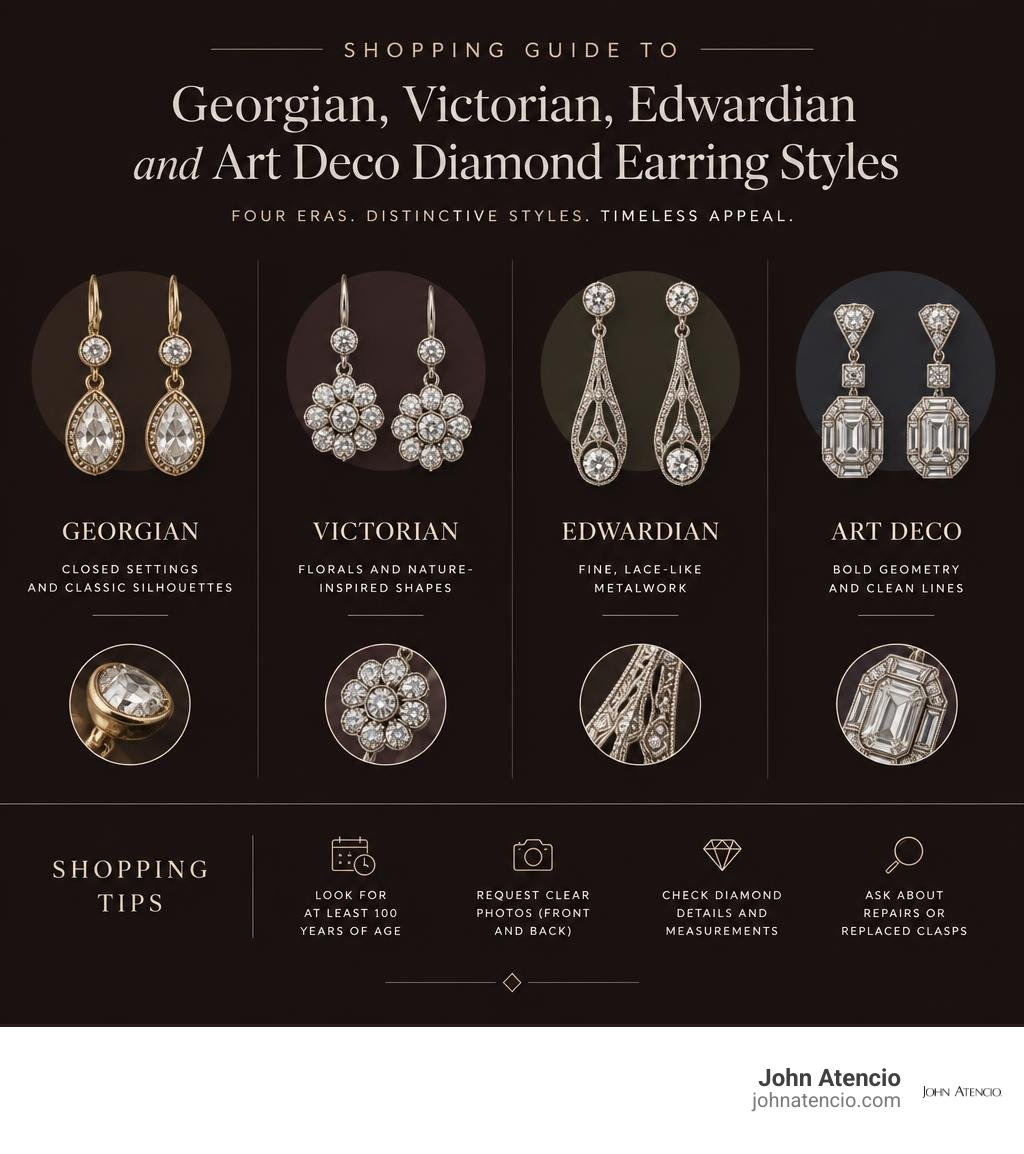
Start with the style you want to wear. Georgian drops often have closed settings; Victorian pairs favor flowers and other nature-inspired shapes; Edwardian earrings have fine, lace-like metalwork; and Art Deco designs use bold geometry. For a true antique pair, look for earrings made at least 100 years ago. Ask the seller for clear photos of the front and back, diamond details, measurements, and any repairs or replaced clasps before you buy.
I'm Lex Atencio, Executive Vice President at John Atencio. My work in fine jewelry shapes how I assess antique diamond earrings: first for design, then for condition and wearability. If you order from John Atencio, we typically ship via FedEx 2-day service; we do not ship internationally to customers.
Identifying Key Eras and Historic Diamond Cuts
Essential Eras for Antique Diamond Earrings: Georgian to Art Deco
Every design movement produced unique silhouettes, mounting techniques, and stone selections. When evaluating estate jewels, understanding the context of each era helps you recognize authentic craftsmanship.
- Georgian Era (1714–1830): Georgian diamond earrings are exceptionally rare. Jewelers crafted drops and girandole earrings by encasing diamonds in pinched collets—metal rims crimped around the girdle of the stone. These pieces almost always featured closed backs, often lined with reflective metal foils to enhance brilliance under candlelight. Notable examples include ornate drop styles, such as exquisite Regency diamond drop earrings crafted during the early 19th century.
- Victorian Era (1837–1901): Queen Victoria’s reign spanned several aesthetic shifts. Early Romantic pieces showcased nature motifs, snake designs, and floral clusters. Mid-century and Grand Victorian styles introduced openwork gold wire, astral motifs, and expressive dangle drops. Striking examples like antique Victorian emerald and diamond earrings or floral cluster earrings mounted in mixed metals reflect the period's love for naturalistic artistry. Late Victorian pieces saw the rise of buttercup settings, open knife-edge mountings, and crescent drops.
- Edwardian Era (1901–1915): The Edwardian period championed airy lightness and monochromatic elegance. Jewelers utilized platinum to create delicate, lace-like garland motifs, bows, and tassels. These earrings favored milgrain detailing, knife-edge wire connections, and refined articulation.
- Art Deco Era (1920–1939): Known for architectural precision, the Art Deco era embraced sharp geometry, step-cut contours, and contrasting black-and-white palettes (often pairing diamonds with onyx or enamel). Drop earrings became elongated and streamlined to match the bobbed hairstyles of the Roaring Twenties.
| Era | Prominent Design Motifs | Typical Diamond Cuts | Metal Construction | Setting Methods |
|---|---|---|---|---|
| Georgian (1714–1830) | Girandoles, ribbon bows, pendeloque drops | Rose Cut, early Table Cuts | Silver tops with high-karat yellow gold backs | Closed-back pinched collets, foiled mountings |
| Victorian (1837–1901) | Florals, crescents, stars, serpents, buttercups | Old Mine Cut, Rose Cut, early Old European | Silver-topped gold, 18K/14K/10K yellow and rose gold | Open-back crowns, claw prongs, cut-down collets |
| Edwardian (1901–1915) | Garlands, bows, wreaths, lace-like filigree | Old European Cut, Rose Cut melee | Platinum, platinum-on-yellow-gold | Milgrain edges, knife-edge articulated drops |
| Art Deco (1920–1939) | Stepped patterns, linear drops, geometric shields | Old European Cut, Baguettes, Asscher Cuts | Platinum, 18K white gold | Calibre channel settings, bezel wraps, flush pavé |
Historic Faceting: Rose Cuts, Old Mine, and Old European
Historic diamonds were cut by hand rather than calibrated by modern computer software. Master cutters relied on natural daylight and their own eyes to release the inner warmth of the rough crystal, crafting unique proportions designed to flicker in candlelit ballrooms.
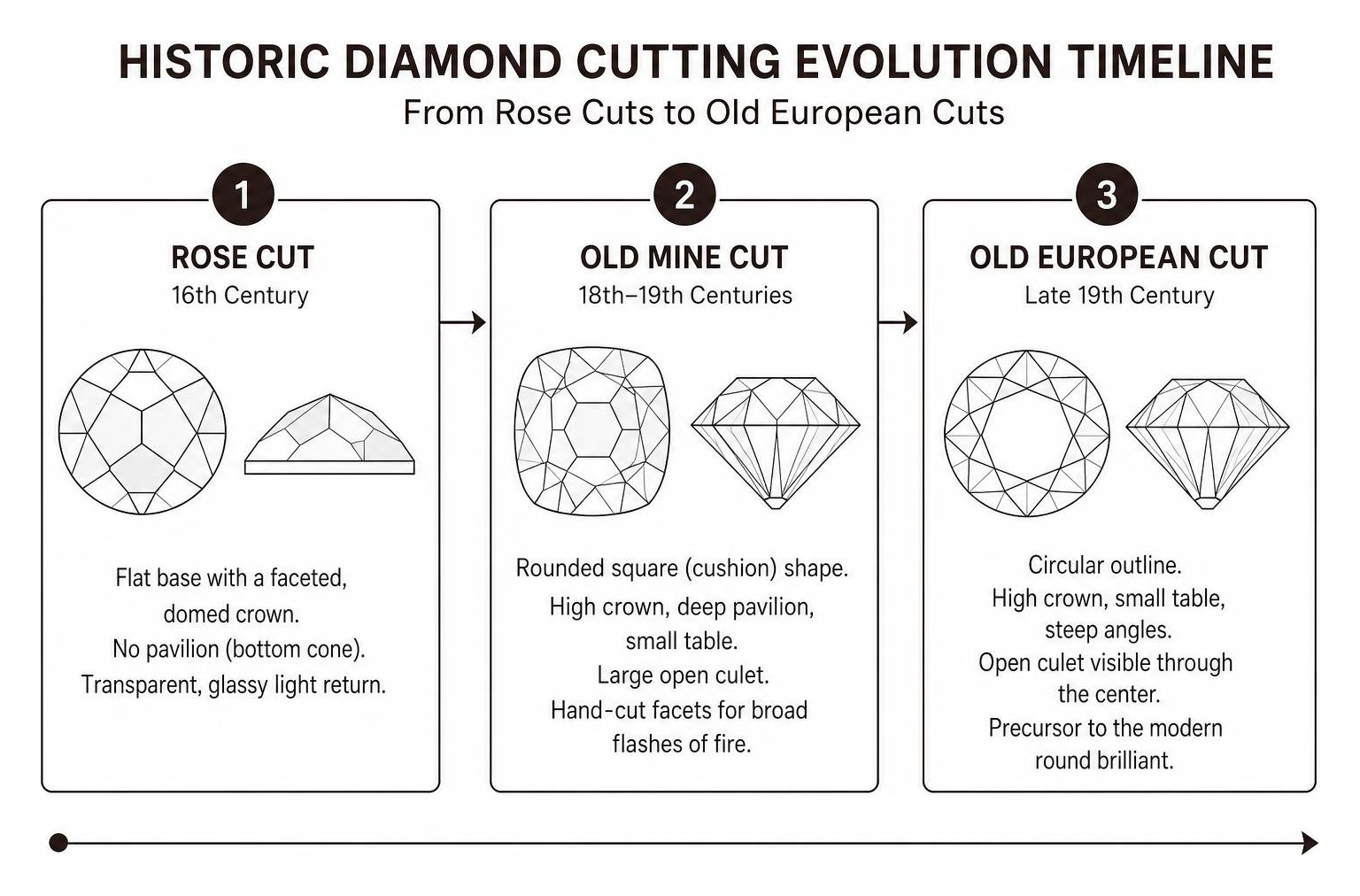
The oldest historic style frequently found in earrings is the Rose Cut, which dates back to the sixteenth century. Unlike modern stones, rose cuts feature a flat base with a faceted, domed crown resembling the petals of an unfurling rosebud. Because they lack a pavilion (the bottom cone), their light return is transparent and glassy. Collectors love antique rose cut diamond earrings for their gentle glow.
During the 18th and 19th centuries, the Old Mine Cut became the standard. Resembling a rounded square or antique cushion cut, Old Mine cuts feature a high crown, a deep pavilion, a small table, and a large, polished open culet at the bottom. Each individual facet was placed by hand, creating broad flashes of fire.
By the late 19th century, the advent of mechanized steam-driven bruting machines paved the way for the Old European Cut. As the direct predecessor to the modern round brilliant cut, the Old European cut possesses a circular outline while retaining a high crown, small table, steep angles, and an open culet visible through the stone's center.
Setting Styles, Metals, and Gemstone Accents
Metal Craftsmanship: Silver-Topped Gold to Platinum
Before the early 20th century, setting diamonds directly into white metal presented a metallurgical challenge. While white settings were preferred to keep yellow hues from reflecting into white diamonds, white gold had not yet been commercially formulated, and platinum required torch temperatures that 19th-century jewelers could not produce.
To solve this, master artisans used a technique called silver-topped gold. Diamonds were set into sterling silver on the face of the earring to accentuate the stones' brightness, while a backing of yellow gold was fused behind it. Understanding what is gold alloys' reactivity explained this practice: wearing unbacked silver against bare skin or earlobes caused dark oxidation from perspiration, but a rich gold back kept jewelry comfortable and tarnish-free. Authentic period pieces like antique diamond drop earrings in silver and gold highlight this layered construction.
Around the turn of the century, the invention of the oxyacetylene torch enabled jewelers to work with pure platinum. Because platinum is strong and ductile, artisans created gossamer-thin knife-edge mounts, wirework drops, and micro-prongs that secured gems with minimal visible metal.
Settings and Colored Gemstone Pairings
Antique mountings relied on meticulous hand fabrication rather than mass-market casting. An estate earring might display a seamless bezel setting hand-burnished around an uneven rose cut, or a field of grain-set pave diamonds framing a center stone. For an overview of how mountings hold gems securely, explore everything you need to know about jewelry settings.
Victorian and Georgian jewelers regularly paired diamonds with colored gemstones to create vibrant contrasts:
- Precious Color: Vibrant emerald gem accents, fiery ruby halos, and velvety blue sapphires brought rich saturation to diamond clusters, as seen in period-correct floral cluster earrings.
- Opaque and Vivid Minerals: Robin’s egg turquoise, rich lapis lazuli, and colorful banded agates framed central diamond stars.
- Natural and Organic Elements: Jewelers frequently integrated seed pearls, carved shell, and organic gemstones into romantic bridal dangles.
- Intricate Stonework: Many regional pieces featured precision lapidary work and inlay jewelry techniques that seated colored hardstones flush against engraved metal borders.
Guide to Valuing and Buying Antique Diamond Earrings
Pricing Factors: Natural Diamonds and Carat Weights
The market value of antique diamond earrings depends on design integrity, historic rarity, metal purity, total diamond weight, and preservation state. Unlike modern stones graded strictly on laboratory certificates, antique diamonds are valued for their hand-cut charm and period setting.
| Historical Era | Typical Diamond Weight Range | Common Setting Metals | Key Value Drivers |
|---|---|---|---|
| Georgian | 0.50 ctw to 4.00+ ctw | Silver-topped yellow gold, Pinchbeck | Original foiled backings intact, matched drops, lack of water damage |
| Victorian | 0.25 ctw to 5.00+ ctw | 9K, 10K, 14K, 18K Gold, Silver | Intact original articulated drops, rare motifs, maker's hallmarks |
| Edwardian | 0.75 ctw to 3.50+ ctw | Platinum, Platinum over 18K Yellow Gold | Crisp milgrain work, fine filigree condition, well-matched European cuts |
| Art Deco | 1.00 ctw to 6.00+ ctw | Platinum, 18K White Gold | Geometric balance, clean step-cut accents, signed historic jewelry house marks |
When investing in genuine estate fine jewelry, look for well-matched pairs. Because antique diamonds were cut by hand, finding two stones with matching diameters, crown heights, and color temperatures is uncommon and commands a premium.
The Ethical Appeal of Circular and Vintage Jewels
For many collectors, antique jewelry represents the ultimate circular economy. Choosing an authentic 100-year-old jewel means acquiring a piece with zero modern mining impact, repurposing existing historical resources without disturbing natural habitats.
If you appreciate the warm geometry of historic design but want the security of modern structural casting, vintage-inspired engagement rings and newly created estate-style earrings offer the ideal balance. Modern collectors often explore the appeal of lab-grown diamond stud earrings alongside heirloom pieces to build an ethical, versatile jewelry wardrobe.
Sizing, Mechanisms, and Preserving Delicate Heirlooms
How to Inspect and Authenticate Antique Diamond Earrings
Authenticating antique jewelry requires a careful eye. Because fraudulent reproductions and later assembly pieces exist in the marketplace, examine prospective purchases closely:
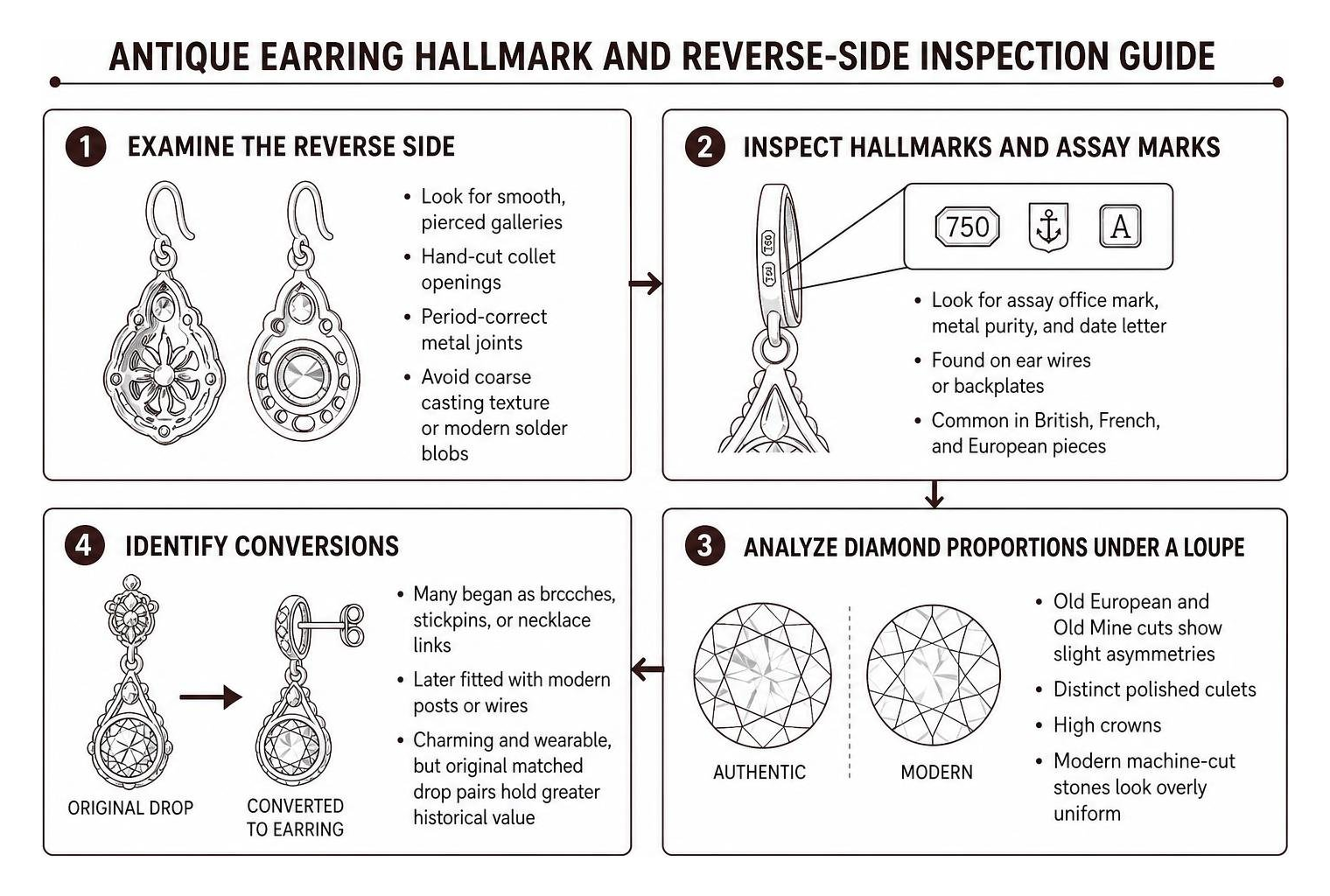
- Examine the Reverse Side: Genuine antique earrings feature beautiful hand-finishing on their backplates. Look for smooth, pierced galleries, hand-cut collet openings, and period-correct metal joints. Replicas often exhibit coarse casting texture or modern solder blobs.
- Inspect Hallmarks and Assay Marks: British, French, and European jewelers used strict hallmarking systems that stamped the assay office, metal purity, and year of manufacture directly onto ear wires or backplates.
- Analyze Diamond Proportions Under a Loupe: Authentic Old European and Old Mine cut diamonds show slight asymmetries, distinct polished culets, and high crowns. Modern machine-cut stones set into vintage-style mountings will look overly uniform.
- Identify Conversions: Many antique earrings began life as Victorian brooches, stickpins, or necklace links that were later converted with modern earring posts or wires. While conversion pieces remain charming and wearable, authentic matched drop pairs from the original era hold greater historical value.
Wearability, Fastenings, and Maintenance
Historic earrings were engineered with different earring backs than modern friction posts:
- Kidney Wires and French Hooks: Long, curved wires popular in the 19th century that slide through the ear and hook into a small catch at the bottom.
- Lever Backs: Hinged spring backs that snap closed behind the earlobe, providing exceptional security for articulated drop earrings.
- Screw Backs: Non-pierced threaded mechanisms popular in the early 20th century before ear piercing regained widespread popularity.
When maintaining heirloom jewelry, proper cleaning techniques are essential to prevent irreparable damage. Never clean antique diamond earrings in an ultrasonic cleaner or with harsh commercial chemical dips. Ultrasonic vibrations can shatter internal inclusions in antique diamonds, crack heat-sensitive emeralds, or loosen stones from fragile hand-crimped collets. If water gets behind the closed foils of a Georgian earring, it will oxidize the metal foil, turning the diamond permanently dark.
For detailed guidance on taking care of delicate antique settings, learn how to clean and repair old jewelry safely using soft natural-bristle brushes, mild surfactant soaps, and warm water.
Frequently Asked Questions About Antique Diamond Earrings
What is the difference between antique and vintage diamond earrings?
In the jewelry trade, an item must be at least 100 years old to be classified as antique. As of 2026, any pair made in 1926 or earlier—including Georgian, Victorian, Edwardian, and early Art Deco pieces—meets the antique standard. Pieces crafted between 20 and 99 years ago (such as mid-century Retro, Mid-Century Modern, and 1980s designs) are categorized as vintage. Both antique and vintage pieces can incorporate a personalized birthstone to celebrate special occasions and milestones.
Are antique diamond earrings durable enough for daily wear?
Antique diamond earrings are durable enough for regular wear if their fastenings, claws, and bezels are in good structural condition. However, because older metals and delicate step cut diamonds or thin claws can wear down over a century of handling, inspect the prong tips annually. Remove antique earrings before sleeping, showering, exercising, or swimming.
How do I know if an antique diamond earring has been converted from a brooch?
Inspect the back of the earring under magnification. A converted piece will often reveal small solder remnants, clipped pin hinges, or tiny spots where a catch was removed before modern ear posts were added. Additionally, check whether the setting styles—such as a side channel setting or milgrain bezel—match the ear wire's era and metal alloy.
Finding Your Next Heirloom Statement
Antique diamond earrings connect you directly to the history, artistry, and romantic craftsmanship of the past. Whether you are drawn to the fiery hand-cut facets of a Victorian drop or the refined geometry of an Art Deco cluster, estate jewels offer an unmatched sense of individuality.
At John Atencio, we share this deep passion for architectural balance, structural integrity, and expressive fine jewelry. Explore our curated selection of diamond stud earrings for women to discover modern wearable styles designed to become tomorrow's cherished family heirlooms. We hand-craft each piece with responsibly sourced materials and fine natural or lab-grown diamonds. When you order from our in-stock collections, we typically ship via FedEx 2-day service; we only ship internationally to Canada.
