
Navette Glamour: Buying and Styling Art Deco Marquise Engagement Rings

The Anatomy and Allure of Art Deco Marquise Engagement Rings
Art Deco marquise engagement rings pair the elongated navette diamond with the bold geometry, symmetry, and architectural lines of 1920s design. The marquise cut itself predates the twentieth century. Legend holds that King Louis XV of France commissioned a stone cut in the silhouette of the Marquise de Pompadour's lips in the mid-18th century, giving rise to the classic "navette" (little boat) shape. When the 1920s arrived, the Art Deco movement adopted this distinctive silhouette, fusing historical elegance with modern, industrial vitality.
Art Deco jewelry celebrated the machine age, characterized by bold symmetry, clean lines, and architectural harmony. Rather than feeling overtly ornate, the marquise became a natural centerpiece for dramatic geometric compositions. The elongated silhouette creates an elegant visual lengthening on the finger while maximizing surface area relative to carat weight, giving the stone an impressive presence on the hand. Today, art deco marquise engagement rings continue to capture this same dramatic balance of vintage romance and architectural precision.
When exploring engagement rings with fancy cut diamonds, the marquise stands out for its bold, dynamic geometry and timeless visual balance.
Signature Elements in Art Deco Marquise Engagement Rings
To capture the architectural glamour of the 1920s, designers integrated specific structural and decorative motifs that framed the center stone. When looking at these pieces, several key design features stand out:
- Milgrain Beading: Minute metal beading applied along geometric borders to add delicate texture, vintage depth, and artisan contrast.
- Stepped Baguette Side Stones: Tapered or straight baguette diamonds arranged in geometric steps that direct the eye inward toward the navette center.
- Geometric Halo Framing: Hexagonal, octagonal, or shield-shaped halos that transform the soft curved edges of the marquise into an angular, architectural showcase.
- Openwork Filigree: Intricate pierced metalwork beneath the gallery, allowing light to circulate freely while keeping the setting visually light.
- Knife-Edge Shanks: Tapered bands featuring a central ridge that reflects light along a single, crisp line, accentuating the geometric balance of the ring.
These decorative elements require precision craftsmanship and expert engineering. Discovering how to craft secure marquise diamond settings ensures that both the delicate milgrain work and structural integrity remain intact over a lifetime of wear. Many of these settings also incorporate subtle chevron patterns along the shoulders, echoing the angular tips of the marquise and reinforcing the overall sense of movement and symmetry that defines the Deco era.
Genuine Antique vs. Modern Art Deco Marquise Engagement Rings
Choosing between an authentic antique (dating from roughly 1920 to 1935) and a modern reproduction involves weighing historical provenance against modern durability. Antique rings were often produced using die-struck platinum or early white gold alloys, frequently featuring hand-cut side stones like Old European or single-cut diamonds. Modern bespoke pieces are cast with high-performance modern alloys and calibrated modern brilliant accents for maximum light performance.
For many couples, modern vintage-inspired engagement rings deliver the aesthetic charm of the jazz era alongside the structural strength required for modern daily life.
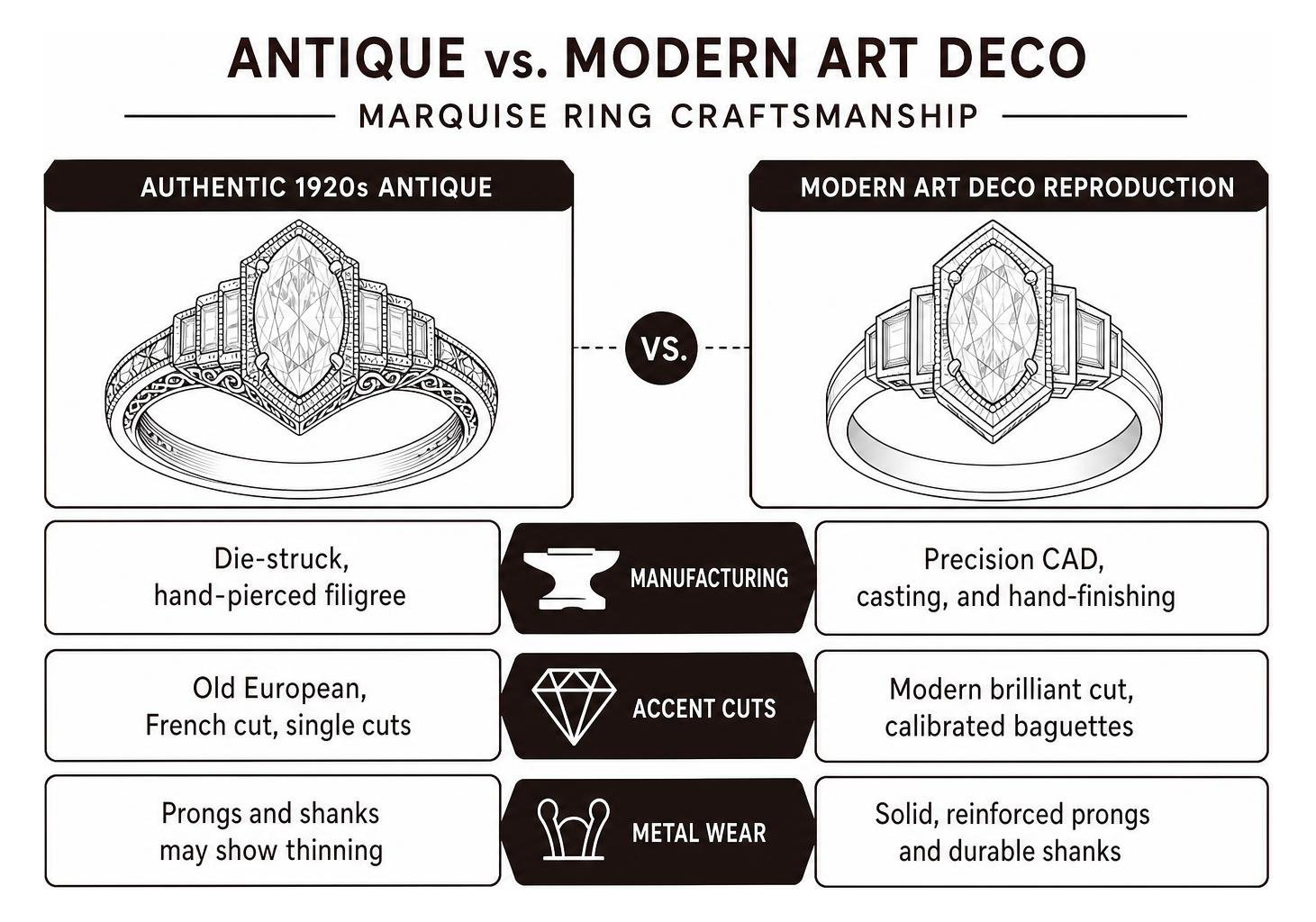
| Feature | Authentic 1920s Antique | Modern Art Deco Reproduction |
|---|---|---|
| Manufacturing | Die-struck, hand-pierced filigree | Precision CAD, casting, and hand-finishing |
| Accent Cuts | Old European, French cut, single cuts | Modern brilliant cut, calibrated baguettes |
| Metal Wear | Prongs and shanks may show thinning | Solid, reinforced prongs and durable shanks |
| Gemstone Condition | Potential facet abrasion or micro-chips | Pristine cutting with optimized light return |
| Customization | Fixed sizing and non-changeable mounts | Fully custom stone choice, scale, and metal |
Gemstone Selections and Precious Metals for Art Deco Styles
While classic white diamonds remain the hallmark of Art Deco styling, modern fine jewelry allows for versatile stone selections. Natural diamonds offer timeless provenance, while lab created diamond engagement rings deliver identical chemical, optical, and physical brilliance with modern innovation.

Colored gemstones were also widely celebrated during the 1920s. Deep blue sapphires, vibrant emeralds, and contrasting black onyx were frequently set against white diamonds to create bold, dramatic contrast. Setting colorful side baguettes or calibrated gemstone halos around a brilliant marquise diamond infuses striking period character while highlighting the symmetry of the central stone.
Period Metals and Contemporary Color Finishes
Metal choice sets the tonal foundation for any vintage-inspired design:
- Platinum: The quintessential Art Deco metal. Naturally white, dense, and hypoallergenic, platinum holds crisp milgrain details and fine openwork exceptionally well over decades of wear.
- White Gold: Brilliant and reflective, modern white gold engagement rings capture the crisp monochrome aesthetic of the 1920s while offering lightweight durability and exceptional value.
- 18k Yellow Gold: Warm and radiant, yellow gold provides rich contrast against colorless diamonds, emphasizing geometric lines with an heirloom glow.
- 14k Rose Gold: A romantic modern alternative that introduces soft blush warmth to angular Deco silhouettes.
- Two-Tone Combinations: Combining a yellow gold band with a white gold or platinum head keeps diamonds looking icy white while providing two-tone styling versatility.
Expert Buying Guide: Quality, Pricing, and Custom Design
Selecting a marquise diamond requires careful attention to shape ratio, facet alignment, and overall symmetry. Because of its elongated brilliant faceting, a marquise diamond can exhibit a "bow-tie" effect—a dark shadow across the center of the stone caused by light escaping through the pavilion. A masterfully proportioned cut minimizes this shadow, distributing brilliance and fire evenly from tip to tip.
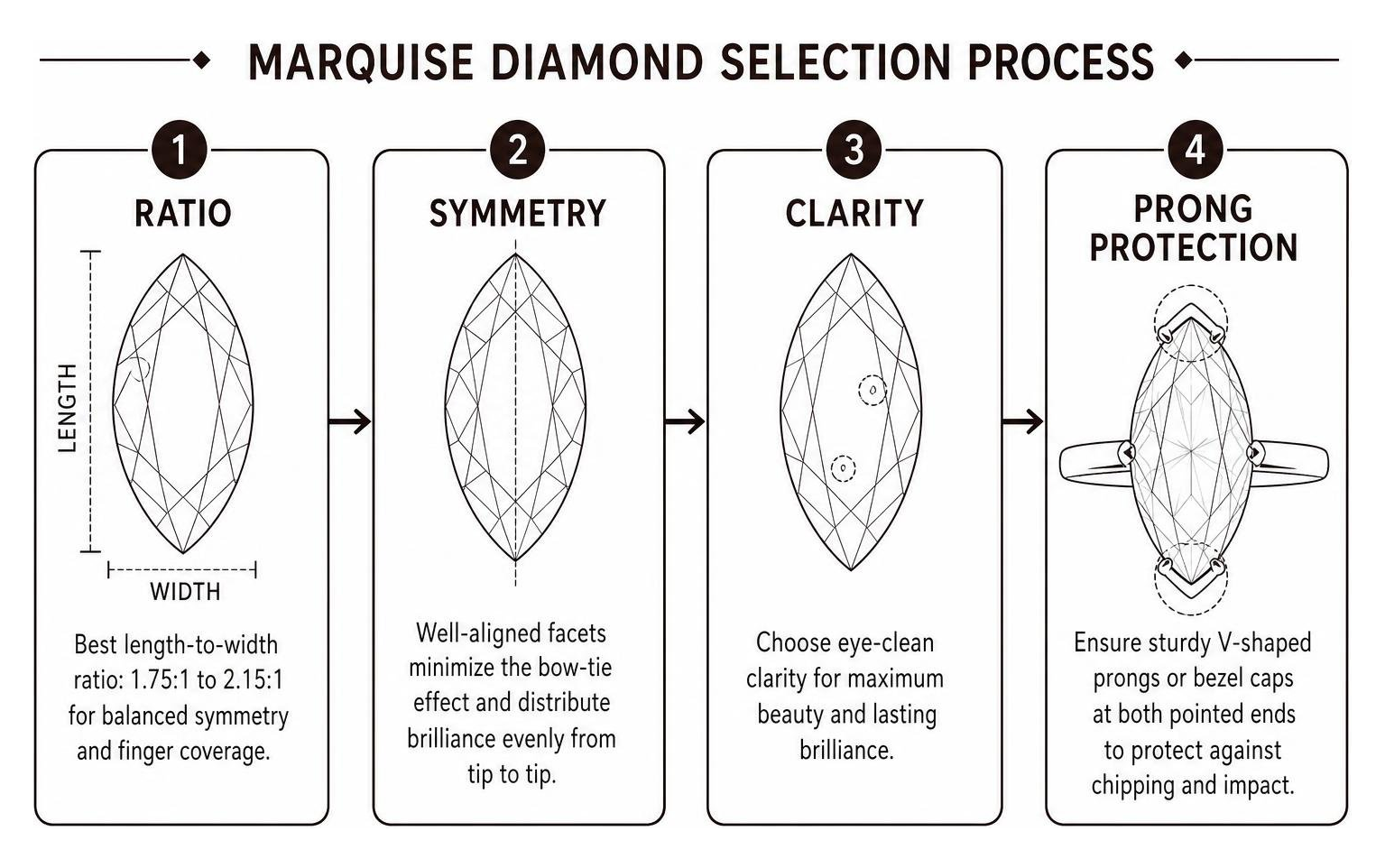
When selecting your stone, consider these important factors:
- Length-to-Width Ratio: A classic marquise ratio typically ranges between 1.75:1 and 2.15:1, balancing generous finger coverage with refined, balanced symmetry.
- Point Protection: Always ensure the setting features sturdy V-shaped prongs or protective bezel caps at both pointed ends to shield them securely from daily impact.
- Independent Certification: Select stones with laboratory certification, such as the Gemological Institute of America, to guarantee authentic and unbiased grading for cut, color, clarity, and carat weight.
- Bespoke Design: Exploring custom engagement ring styles allows you to tailor geometric frames, shoulder baguettes, and metal choices directly to your preferences.
Carat weight is another consideration worth discussing with your jeweler, since the elongated marquise shape can appear larger than round or cushion cuts of a comparable weight. Rather than focusing on specific pricing, which varies widely based on carat, clarity, and metal selection, it is best to work directly with a jeweler to determine a budget that reflects your priorities for size, quality, and craftsmanship.
If you are beginning your search by selecting a center stone, we invite you to view loose diamonds to compare facet brilliance firsthand. Our personalized engagement ring process ensures every structural element is designed specifically around your chosen gemstone to highlight its unique proportions and maximum brilliance.
Styling and Pairing Bands with Marquise Silhouettes
Due to the extended points of the marquise center stone, pairing a straight wedding band can sometimes leave a gap between the two rings. Several curated options ensure a seamless bridal stack:
- Pointed V-Bands (Chevron): Mimic the angles of the marquise tip, nesting flush against the engagement ring.
- Contoured Bands: Gently curve around the center stone's setting, offering a tailored fit without altering the ring's profile.
- Ring Jackets: Surround both sides of the marquise with symmetrical diamond accents to amplify the Art Deco aesthetic.
For a refined balance of vintage drama and modern minimalism, exploring unique engagement rings like our Essence Solitaire Marquise Engagement Ring showcases how clean, sculptural lines frame the navette silhouette effortlessly.
Frequently Asked Questions About Art Deco Marquise Rings
How do I protect the pointed tips of a marquise diamond?
The pointed ends of a marquise cut are its most vulnerable areas. Ensure your ring utilizes protective V-shaped prongs (chevron prongs) or dedicated metal end-caps that envelop the tips entirely. Regular inspections by an experienced jeweler help verify that prongs remain tight and free of snags.
Can an authentic vintage Art Deco marquise ring be resized?
Resizing depends on the ring's structural integrity and how far the decorative pattern extends around the band. Rings with full-eternity engraving or delicate filigree shanks require precision laser welding to preserve the pattern. An appraisal and inspection by a master jeweler should always precede sizing.
What wedding band designs look best with a marquise engagement ring?
Curved nesting bands, chevron V-bands, and open cuff rings complement the marquise profile without crowding the center stone. If you prefer straight bands, a high-set basket allows standard bands to slide directly underneath for a flush fit.
Designing Your Timeless Marquise Statement
At John Atencio, every engagement ring is treated as a piece of wearable art, balancing architectural lines with comfortable everyday wear. Whether you are drawn to the geometric grandeur of the 1920s or desire a sleek modern adaptation, our team brings your vision to life with precision and care.
In-stock styles typically ship via FedEx 2-day service, while custom engagement rings and special orders are individually hand-crafted in 6–8 weeks. We are also pleased to confirm that online orders can be shipped throughout the U.S and to Canada.
To continue refining your silhouette preferences, take a moment to explore the differences between pear cut and marquise cut diamonds and discover the piece that tells your unique story.
