
The Ultimate 1 Carat Solitaire Diamond Price Guide

When calculating a 1 carat diamond solitaire ring price, it helps to remember that an engagement ring consists of two core components: the loose center diamond and the precious metal mounting (setting). While the center diamond usually claims 75% to 90% of your total budget, the choice of metal, setting design, and overall ring architecture complete the equation.
Understanding how these elements interact gives you control over your purchase. When evaluating center stones, diamond pricing does not scale linearly with weight. Because gem-quality diamonds become exponentially rarer as they grow in size, a 1.00 carat diamond costs significantly more than two 0.50 carat diamonds combined.
Beyond weight, the final cost reflects setting fees, side-stone work (if adding subtle accents), hand-finishing, and metal choice. To better understand how individual diamond parameters dictate market values before adding a setting, explore our detailed diamond pricing guide.
How Natural vs. Lab-Grown Diamonds Impact 1 Carat Diamond Solitaire Ring Price
The choice between a natural and a lab-grown center stone is one of the most substantial financial decisions you will make when shopping for a solitaire ring. Both options offer optical, chemical, and physical identity—they are visually identical to the naked eye and graded on identical scales by major gemological institutes. However, their market prices diverge dramatically due to supply dynamics.
Natural diamonds formed billions of years ago deep within the Earth's mantle under extreme heat and pressure. Because gem-grade natural rough is finite and costly to extract, natural stones command higher prices and retain long-term value. As of mid-2026, loose 1 carat round natural diamonds span a market range from $450 for lower structural grades up to $13,083 for flawless stones, with an industry average price of $4,061 and a median benchmark of $3,686. You can review live market variations across loose natural stones through 1 Carat Round Natural Diamond Prices | Compare from $450 | CaratRadar.
By contrast, lab-grown diamonds are created over weeks using advanced technological processes like High Pressure High Temperature (HPHT) or Chemical Vapor Deposition (CVD). Advanced production efficiencies have driven down prices. Currently, a loose 1 carat lab-grown diamond averages approximately $720 with a median around $628, spanning from under $100 to over $9,000 for rare specialty cuts and high specifications. Explore current lab-grown stone data via 1 Carat Lab Grown Diamond Prices | Compare from $68 | CaratRadar.
The Role of the 4Cs in Determining Diamond Value
The global benchmark for diamond valuation relies on the 4Cs: Cut, Color, Clarity, and Carat Weight. Balancing these four attributes lets you maximize your 1 carat diamond solitaire ring price without compromising visual performance.
- Cut Quality: This is the single most critical factor determining a diamond's fire, brilliance, and scintillation. A stone with superior proportions reflects light back through the top, making the diamond appear bright and lively. Compromising on cut produces a dull, lifeless stone, regardless of how flawless its color or clarity might be.
- Color Grade: Graded on an alphabetical scale from D (colorless) to Z (light yellow or brown), color grades affect pricing noticeably. D through F grades command premium pricing. However, G and H grades belong to the near-colorless range and appear crisp and white once mounted in a solitaire ring, saving you 15% to 20% compared to colorless grades.
- Clarity Grade: Evaluated from Flawless (FL) down to Included (I1-I3), clarity measures internal blemishes and inclusions. For a 1 carat stone, VS2 or eye-clean SI1 clarity grades offer exceptional value because their inclusions are invisible to the unassisted human eye.
- Carat Weight: Carat measures physical weight (where 1.00 carat equals 200 milligrams). Crossing full-carat thresholds triggers steep price increases due to psychological market demand.
To dive deeper into setting your quality baseline, review our thorough breakdown on the 4cs of diamond quality and learn how to pick a diamond tailored to your personal aesthetic.
1 Carat Diamond Solitaire Ring Price Breakdown by Quality Level
To clarify what your budget can buy, we have categorized the total cost of finished 1 carat solitaire rings into clear quality tiers. A complete ring price combines the loose center stone with a high-quality solid gold or platinum mounting.
Across the natural diamond market, the industry average price for a standalone 1 carat round natural diamond rests around $4,435. When paired with an artisanal solitaire mounting, typical finished natural rings land between $5,000 and $8,500 for popular configurations, as supported by data in this How Much Does a 1 Carat Round Natural Diamond Cost? (2026 Guide).
| Quality Tier | Diamond Specifications (Natural) | Center Stone Cost | Setting Cost (14k/18k/Plat) | Total Finished Ring Price |
|---|---|---|---|---|
| Budget Value | I-J Color, SI1-SI2 Clarity, Good/Very Good Cut | $2,200 – $3,300 | $600 – $1,200 | $2,800 – $4,500 |
| Sweet Spot | G-H Color, VS2-SI1 Clarity, Excellent/Ideal Cut | $4,000 – $6,800 | $800 – $1,700 | $4,800 – $8,500 |
| Premium Tier | F-G Color, VS1-VS2 Clarity, Excellent/Ideal Cut | $7,000 – $11,500 | $1,000 – $2,200 | $8,000 – $13,700 |
| Exceptional Tier | D-E Color, VVS1-IF Clarity, Ideal/Hearts & Arrows Cut | $12,000 – $16,000+ | $1,200 – $3,000+ | $13,200 – $19,000+ |
Comparing 1 Carat Diamond Solitaire Ring Price Across Quality Tiers
- Budget Tier ($2,800 – $4,500 Total): This tier pairs a natural diamond featuring slightly warmer tones (I-J color) and minor inclusions (SI1-SI2) with a classic 14k gold solitaire setting. While budget-friendly, careful inspection is needed to ensure the stone is eye-clean and free of inclusions directly under the table.
- Sweet Spot Tier ($4,800 – $8,500 Total): This represents the ideal balance of beauty and expenditure. Selecting a G or H color paired with VS2 clarity and an Excellent cut delivers a white, fiery appearance with zero eye-visible inclusions. Paired with a 14k or 18k gold mounting, this tier accounts for the majority of standard engagement ring purchases.
- Premium Tier ($8,000 – $13,700 Total): Designed for buyers seeking rare specifications, this level features F or G color, VS1 clarity, and top-tier Ideal cut symmetry set in heavy 18k gold or platinum. The light performance is exceptional, and inclusions are difficult to find even under 10x magnification.
- Exceptional Tier ($13,200 – $19,000+ Total): For those seeking near-perfection, this tier incorporates colorless stones (D-E) with microscopic inclusions (VVS1 to Flawless) cut to exacting optical precision, set in custom platinum mountings.
Natural vs. Lab-Grown 1 Carat Solitaire Price Comparison
Comparing natural and lab-grown options highlights dramatic differences in overall purchasing power:
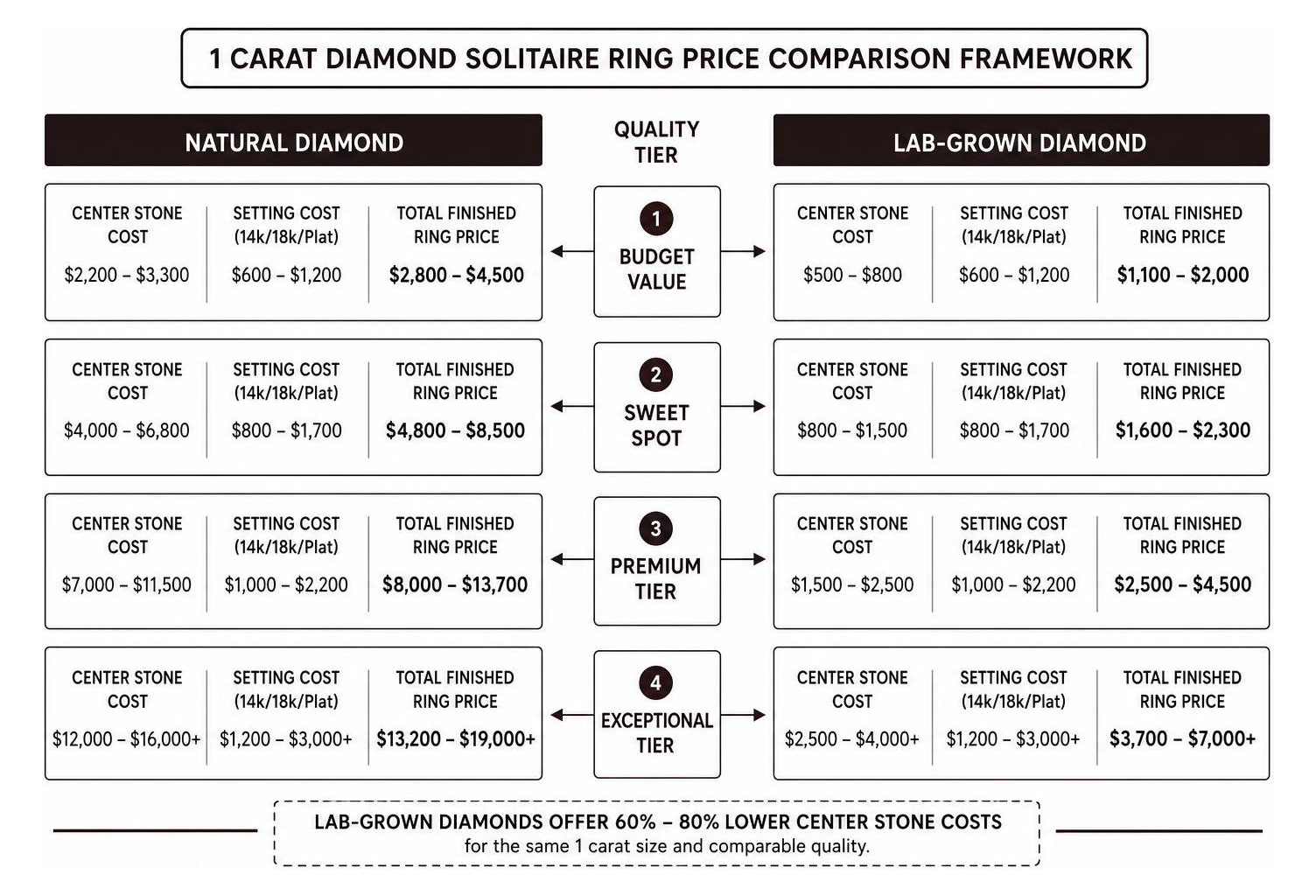
Selecting a lab-grown diamond reduces center stone costs by 60% to 80%. For example, an eye-clean, Excellent-cut 1 carat lab-grown diamond (G/VS2) typically costs $800 to $1,500. Combined with a solid 14k gold solitaire setting ($800), your total finished ring cost comes to approximately $1,600 to $2,300—compared to $5,000 to $8,500 for a natural counterpart of identical grade.
If you are deciding how much of your total budget to allocate toward center stone weight versus setting craftsmanship, read our insight guide on how much should you spend on an engagement ring.
Smart Strategies to Maximize Value on a 1 Carat Solitaire Ring
Maximizing your 1 carat diamond solitaire ring price doesn't mean compromising on beauty. By understanding gemological pricing thresholds and diamond anatomy, you can make strategic decisions that yield significant savings.
When selecting a diamond, small changes in search criteria can free up thousands of dollars in your budget without altering the visual presentation on your partner's finger. For detailed steps on selecting your ideal stone, refer to our expert guide on how to choose an engagement ring diamond.
The Magic Size Strategy: Buying 0.90 to 0.99 Carat Stones
One of the most effective methods to save money on a solitaire ring is leveraging the diamond industry's "magic sizes." Magic sizes are benchmark weight thresholds—such as 0.50, 0.75, 1.00, and 1.50 carats—where prices jump sharply.
Because consumer demand heavily favors exact 1.00 carat weights, cutters strive to keep rough stones at or above 1.00 carat. A diamond that weighs exactly 1.00 carat carries a significant premium compared to a stone weighing 0.92 or 0.96 carats.
- The Price Savings: Choosing a 0.90 to 0.99 carat diamond delivers 10% to 15% savings ($500 to $1,200 on natural diamonds) compared to a 1.00 carat stone with identical color, clarity, and cut grades.
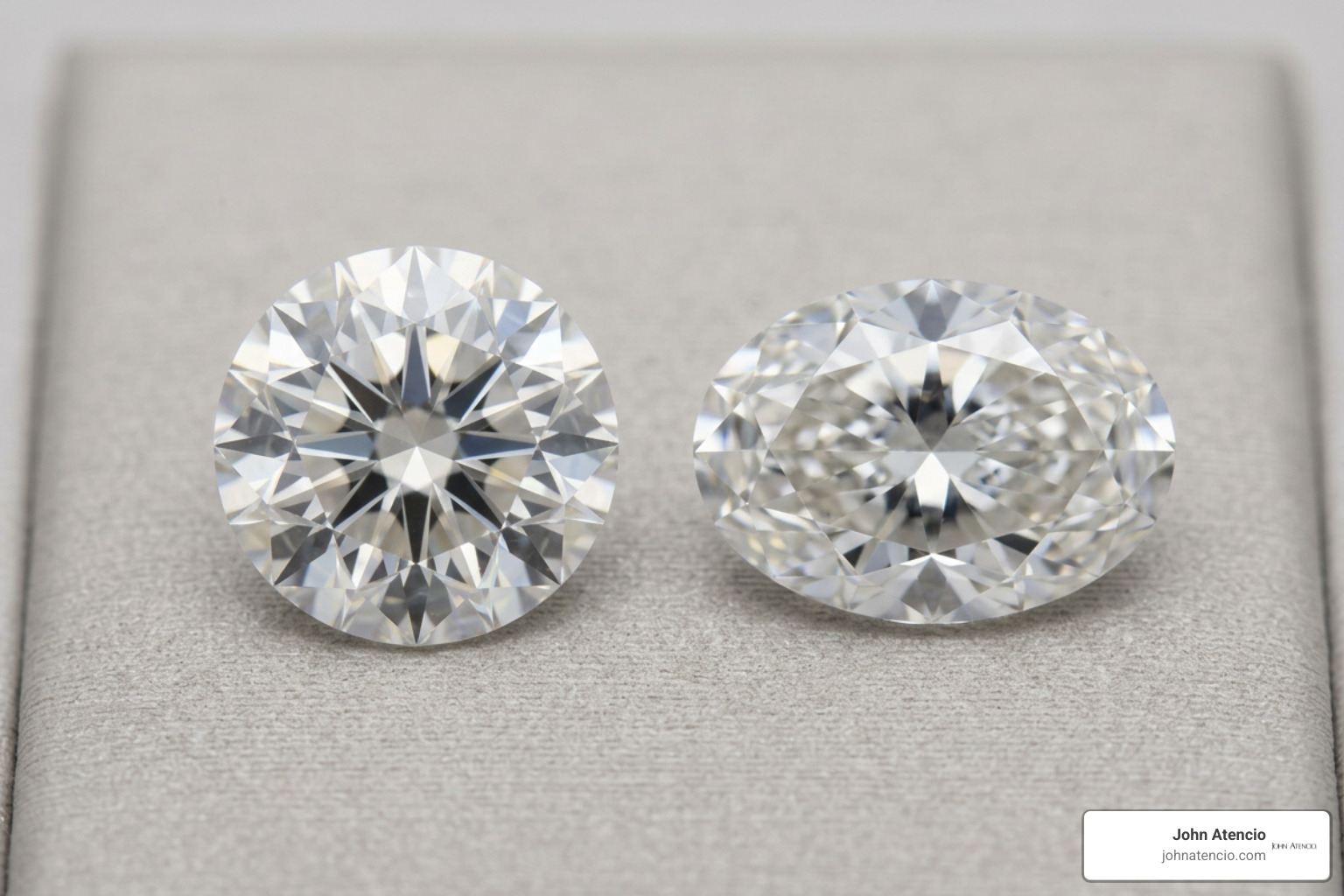
- The Visual Reality: A standard 1.00 carat round brilliant diamond measures approximately 6.50mm in surface diameter. A 0.95 carat round diamond measures approximately 6.40mm. This 0.1mm difference is visually imperceptible to the unassisted eye once set in a solitaire mounting.
To explore how subtle dimensional adjustments influence overall presence, consult our guide on choosing the right carat size.
Fancy Shapes vs. Round Brilliant Premium
Another strategy to lower your 1 carat diamond solitaire ring price is selecting a fancy diamond shape instead of a classic round brilliant cut.
Round brilliant diamonds command a 15% to 30% price premium over fancy shapes (such as oval, cushion, emerald, pear, or princess cuts) of equal carat weight and clarity for two main reasons:
- Rough Stone Waste: Cutting a round brilliant diamond requires polishing away 50% to 60% of the original rough diamond crystal. In contrast, cutting fancy shapes like oval or emerald cuts preserves more rough material, wasting only 30% to 40%.
- Market Demand: Round diamonds account for roughly 75% of global engagement ring sales, maintaining high market demand.
Choosing an oval, cushion, or emerald cut center stone lowers center stone costs while providing unique visual appeal. An oval cut diamond, for instance, offers an elongated outline that often creates the visual illusion of a larger diamond than a round cut of identical weight.
How Setting Choice and Diamond Certification Impact Total Ring Cost
While the center diamond commands the majority of your budget, your choice of solitaire setting and independent diamond certification strongly influence both short-term value and long-term durability.
Solitaire Setting Metals and Style Variations
A solitaire ring setting seems straightforward, but metal choices, prong configurations, and hand-craftsmanship create varying price points. For a detailed overview of mounting options, consult our comprehensive engagement ring buying guide.
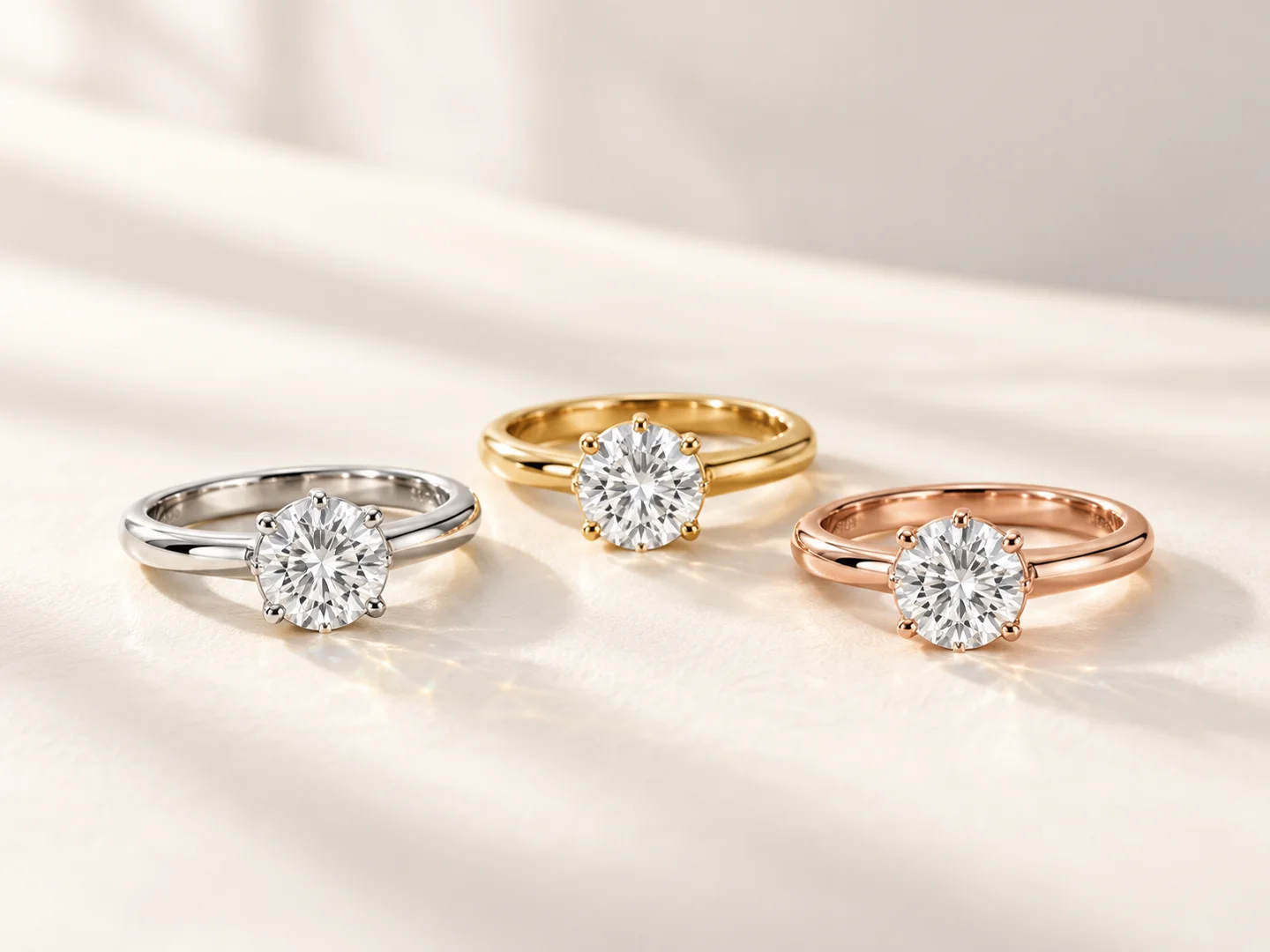
- 14k Gold (Yellow, White, or Rose): Entry-level metal options generally range from $600 to $1,200 for a solid solitaire setting. 14k gold contains 58.3% pure gold alloyed with durable metals, offering structural integrity for daily wear.
- 18k Gold (Yellow, White, or Rose): Containing 75% pure gold, 18k gold delivers a richer, warmer color tone. It generally adds a $200 to $500 premium over 14k gold mountings.
- Platinum: As a dense, naturally white precious metal, platinum is hypoallergenic and exceptionally durable. It does not wear away over time but rather forms a natural patina. Platinum settings typically cost $1,200 to $2,500+ for solitaire styles, representing a premium over gold due to metal density and labor complexity.
- Prong & Bezel Architecture: Four-prong solitaire settings showcase more of the diamond's body, whereas six-prong settings offer extra security. Bezel settings encase the diamond's perimeter in solid metal, providing maximum protection for active lifestyles while slightly increasing metal weight and setting labor costs.
Grading Lab Certification: GIA vs. IGI
Never purchase a natural or lab-grown diamond without an independent diamond grading certificate from an established gemological laboratory. A certification protects your investment by verifying exact 4C parameters.
- Gemological Institute of America (GIA): Recognized as the global gold standard for natural diamond grading. GIA is known for strict, consistent standards in color and clarity evaluation. A GIA-certified diamond holds strong market consistency and resale reliability.
- International Gemological Institute (IGI): While IGI grades natural stones, it has become the primary grading authority for lab-grown diamonds. IGI reports provide detailed analysis of lab creation techniques (CVD vs. HPHT) and precise proportion breakdowns.
Always double-check your certificate details using official laboratory databases before finalizing your ring. Learn more about evaluating laboratory documentation through our guide on diamond certification a quick guide.
Frequently Asked Questions About 1 Carat Diamond Solitaire Rings
What is the average price of a 1 carat round natural diamond solitaire ring?
The total average price for a finished 1 carat round natural diamond solitaire ring typically ranges between $5,000 and $8,500. This reflects an industry sweet-spot diamond (G-H color, VS2-SI1 clarity, Excellent cut) costing roughly $4,000 to $6,800, combined with an artisanal 14k or 18k solid gold setting priced between $800 and $1,700. Lower quality combinations can drop finished prices near $3,000, while premium colorless, flawless stones can drive total prices past $15,000.
How much setting cost should I expect for a solitaire engagement ring?
A solid quality solitaire mounting typically costs between $600 and $2,500, depending on your choice of precious metal and craftsmanship level. Standard 14k gold solitaire bands start around $600 to $1,000, 18k gold settings range from $900 to $1,500, and platinum solitaire mountings range from $1,200 to $2,500+. Custom sculptural work or hand-finished detailing will add to these base metal costs.
Is GIA certification necessary for a 1 carat diamond ring?
For a natural 1 carat diamond, GIA certification is strongly recommended. Because slight variations in color or clarity grades can change a natural stone's value by hundreds or thousands of dollars, GIA's strict grading standards protect you from overpaying for inflated specs. For lab-grown diamonds, IGI certification is widely accepted, reliable, and standard across the jewelry industry. Discover more answering key questions in our diamond education diamond faqs.
Conclusion

Understanding the 1 carat diamond solitaire ring price boils down to balancing center stone attributes with setting craftsmanship. Whether you choose a classic natural diamond or opt for a modern lab-grown stone, focusing on cut quality, targeting eye-clean clarity (VS2/SI1), and exploring magic sizes (0.90–0.99ct) or fancy shapes will help you maximize your overall budget.
At John Atencio, we bring decades of artisanal design, bold sculptural style, and commitment to responsibly sourced materials to every piece we create. Each solitaire setting is designed to showcase your center diamond with balance, structural integrity, and timeless aesthetic power.
Ready to take the next step in crafting your perfect engagement ring? Explore our iconic collection of solitaire diamond engagement rings or use our interactive Ring Builder to design a custom piece that tells your unique love story.